
Monday, December 3, 2007


Tuesday, November 20, 2007

A few years ago I was in a discussion group and and the book we were discussing was Lord of the Rings. We were working our way through the entire book and we’d have these fascinating discussions about the philosophy of the stories. One of the members of the discussion group, however, was a big Tolkien fan and he’d bring in letters or other ways in which we’d learn Tolkien’s view on his own book to dispute whatever point we would be making. I found it immensely annoying - it just totally shut down the discussion. Now we have the Author Himself Telling Us All What He Really Meant. What then was the point of discussing it - the Oracle Has Spoken. What was the point of even reading the story - why shouldn’t he just tell us what he really meant and be done with it?
This is why I think J.K. Rowling made a terrible mistake during her American tour. While I think it would be helpful to hear about her views of the process of writing, or writing as an art form, or to discuss - at length even - what books have influenced her and why, she just gave us too much definitive information on this tour and effectively has nearly shut the discussion down.
As I wrote about in my essay “Iceberg Ahoy” in the book “The Plot Thickens,” the skill of a writer is to tell us just enough information (i.e., Hemmingway’s iceberg analogy) to keep the story going, but not to much - allude to more that is under the surface. This was Rowling’s brilliance in her writing - she gave us enough to sweep us into the story and carrying on discussion that should have lasted into the next century - but not too much to squash the reader’s own journey into the imagination. Her tour of America nearly undid all her skill. It was as though she’s had a “minder” who finally was given the “heave-ho” after the books were completed.
As some may know, I’ve become a Bob Dylan fan and have been spending the last few years trying to play catchup on his lifetime vocation of music. It’s take me three years to get to where I am now, which may mean I might understand the new arthouse film that is about to come out, “I’m Not Here.” But one of the frustrating (wonderful?) things about Dylan is that he very rarely talks about what his songs mean. Early on he might and sometimes something will slip out (but is he telling the truth or fooling around, one never knows). But he really doesn’t tell us what his songs mean. He wrote an entire “first volume” autobiography and still didn’t really tell us what his songs mean - he spent virtually the entire book explaining how he wrote them, not what they mean.
This of course is frustrating - but also an important key to his success and the explosion of his myth. He follows the iceberg theory as well - gives us just enough information but not enough to explain it all to us. We have to work on his songs, we can’t be passive. We can have “aha” moments but until one can sit down with another Dylan fan and argue over the points, one is never going to be sure if one is up the tree or out on a limb or swinging carefree on the mark. But the point always is to make the case from the song themselves and Dylan provides very little to explain it and if he does he isn’t always to be believed.
There are times when I re-read the Dumbledore interview and if Jo Rowling were Bob Dylan you could make the case she was pulling everyone’s leg bigtime, except no one has a sense of humor about such things they are so politicized (with reason) right now. But there is a sense that you could almost imagine the Weasley Twin side of her chuckling.
But if not and she’s serious about all the “revelations” and “opinions” she’s given (and there’s no reason really to seriously doubt her) then she’s spoiled the fun, she’s told us the answer (yes, even after we begged her to) when the better way is to turn the question back to the audience and ask, “What do you think?” and turn the questions back to the audience and have a conversation about it, rather than embarking in that almost celebrity mindedness that everything she says is holy writ. If that is true, then the story is truly “her” story and she owns it like a piece of property to control as she wishes and her audience either gets it or we don’t. But she knows all. Well, that’s a lot of things, but it doesn’t further her story to live beyond herself, to live larger than herself. It might be wise for her to go back to the way it was, when she said little, and if there is something she must say to put it in a book and be done with it. Make the case and tell the story and we’ll judge if she pulls it off. It’s like cheating to tell us all about Luna and her adventures (what was all that stuff about her and Dean and nothing coming from it - what a fascinating and unlikely match that might have been, you could almost see that Dean was entertained by Luna and he offered her stability and sense, but no Jo says she went off to the woods and met someone we’ve never heard of, poor Dean - all that time and it was all for nothing).
And Neville and Hannah - where’s the support for that? Was there any hint in the text about them at all? No, so it becomes almost like gossip, not storytelling. J.K. Rowling toured America gossiping about her characters. I bet a few of them, not the least being Dumbledore, would have liked for her to put a sock in it.
Now we see she is narrow-minded toward something she calls “American fundamentalists.” But she does not define her terms - is she talking about Calvinist Baptists or Evangelical Armenian or what? Isn’t it a stereotype of religious Americans and somehow the British are so much more enlightened? If I were to walk into a Baptist meeting I’d be anything but a fundie - I’m sure they’d find me a progressively liberal. But if I were to attend one my own home denomination, Episcopalian, meeting I’m sure they’d be quick to call me a fundie because I’m not unitarian and I call Jesus by His first name. Jo Rowlings sweeping generalities tells us she doesn’t know America very well and her bias toward her own nation shows. She’s the enlightened one and we’re a bunch of right wing nuts. Maybe she’s trying to be funny.
It was way more fun to discuss her books before she started to explain them to us. I know the temptation must have been great - who knows, perhaps the temptation is great for Dylan sometimes. But his music is strengthened by his silence and perhaps this would be a good time for Jo to get thoughtful and reflect that maybe Harry doesn’t belong to her anymore, that he let her into his life for a spell and now he’s moved on and she’s now like the rest of us, trying to figure out what it all means.
ZR (my HP post name)
WEDNESDAY:
Thanks for the comments, friends - I appreciate it more than I can say that I could post that reflection and get such great comments! And I admit I’d love to read Tolkien’s letters - but again, I might maintain that a work must be able to stand on its own and the author also stands in the shadows and in no longer the oracle - but that may be the fruits over my own rebellion regarding the creative writing workshops that go gaga over authors. A book is a book except when it’s a ego-driven self indulgence. Authors are terrible about figuring out when that happens until it’s almost too late or - like Dylan - they crash.
But I seriously doubt that happened to Tolkien, it was indeed how the letters were used to interpret the text and I still find that troubling. If an author has more to say, write more story. A story takes on a life of its own and can suddenly surprise the author. Jo Rowling is into her “plan” and no one can say it doesn’t work. But at some point, if her work is great (and I think it is) she has to step aside and give it away. Perhaps what we saw was a public process of her doing that.
You all have given me more stuff to think about! Thank you! I do quarrel however on calling Rossetti’s masterpiece and “infernal parody.” I saw the original at the Tate in London (I didn’t realize it’s in Chicago now - are you sure that’s the original?) and it was extraordinary. Here it is: http://www.rossettiarchive.org/img/s168.jpg
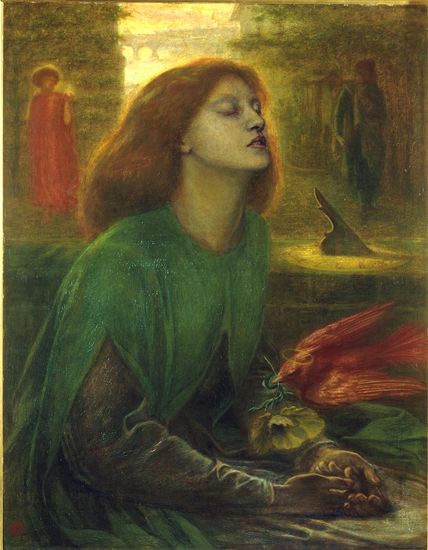
Rossetti was a troubled man, one of the great PreRaphaelites. Again, there is much in the Potter series that lends itself to PreRaphaelite paintings. But the one of “Beatrice” based on the likeness of Rossetti’s late wife (who died I believe from an opium - a toxic potion if there ever was one - overdose) is very Lily-like. And notice the two figures in the background - one is Dante and one is Rossetti himself. We know of another Rossetti/Dante-like character who also lurked in the background and probably knew much of the turmoil those men knew in their art.
From the PreRaphelites to the Beats we see similar themes of the suffering hero who meets a tragic end, a gothic view of sin - certainly not themes of sweetness and light but the peril of the mortal soul. I must read John’s post on Dante before the weekend.
ZR
From here.
Sunday, November 4, 2007

TUESDAY, NOV 4 UPDATE: Read interesting commentary here and here and trademarks and copyrights. This just gets more and more interesting!
More on the Warner Brothers lawsuit against the HP Lexicon here. I am really wondering if the issue isn't so much "copyright" as it is the "trademark" issue and that concerns me very very much on issues of free speech. Isn't the phrase "Harry Potter™" trademarked?
Do you see why we should be concerned?
And I'm sorry, but the "charity" stuff is marketing, it promotes the trademark. If J.K. Rowling was really interested in "charity" she'd follow Rick Warren's example live off 10% and give the rest of the money to charity. The rest is just marketing and it frankly makes me ill. To use "charity" to protect Warner Brothers control over the "trademark" and justify suing the HP Lexicon creator is just unbelievable. I know I'm supposed to be a Republican, but centralized power (be it government or corporations or 815) really ticks me off.
It didn't make sense to initiate lawsuits, except to either frighten fans or establish a precedent this isn't about making the world safe for Jo Rowling's acts of charity - this about controlling the use of a trademark and that is a freedom of speech issue.
Since we know Hermione Granger™ is a lawyer now, perhaps she would like to take on the case of defending the real people against the All Powerful Ministry of Warner Brothers (and the apparently polyjuiced™ author)? Oops, wonder if the word "Hermione Granger™" is trademarked too? Certainly "polyjuice™" must be. Or will be.
Remember back (was it 2002?) when Warner Brothers™ was zapping anyone that used "Harry Potter™" online (okay, I'm old enough to remember), especially the images (but it wasn't just the images, but the way) but also the words invented by J. K. Rowling? It was a public relationships disaster and there was a shift in marketing strategy to use the HP (is that going to be tradmarked as well?) fan websites to market the books and films.
Something has changed.
Remember how Rowling has used the word "invention" when she talks about the HP universe? She's an inventor (not a writer?) and that is a legal term,. She "invented" Harry Potter™. She invented all those other characters and the entire HP universe. Pity the fool to take on the Ministry of Warner Brothers.
Got to thinking this morning if the world of Harry Potter as we know it today is not so much a view of British bureaucracy but rather a quiet scream from Jo Rowling that The Corporation has taken over her life. It might be worth a re-read of the books to see if in fact, the books themselves are a satire and critical review of the very corporation that seeks to impose its will on the last person you'd expect to be AK'd off the planet - the reader.
We are declaring today Steve Vander Ark Day, November 1 - All Saints Day.
bb
LATER (Nov. 5) - Statement from Steve Vander Ark from here.

I would like to thank each and every one of you for your support in recent days. Everyone here at the Lexicon, all volunteers, regrets the unpleasantness. We have always been interested in working with the publishers of the novels to satisfy their concerns, interests and needs and we certainly do not plan nor have we ever planned to publish anything which competes with Ms. Rowling’s fine literary capabilities. Our work has nothing to do with fiction writing and is only concerned with legitimate critical analysis and academic considerations. It has been widely approved and employed by Ms. Rowling herself.
My book was started in response to many, many people who talked to me and asked if there could be a print version of the Lexicon, not in some sort of attempt to profit off of fans. Because the material for the book was not only accepted but praised and used frequently by every entity concerned with creating the Harry Potter books, games, and films, I would never have thought that a print version could be judged differently.
I sincerely hope that this matter can be resolved amicably and ask for you patience and understanding during that process.
Steve
Steve Vander Ark
The Harry Potter Lexicon
EVEN LATER - Tuesday, Nov. 5
Interesting post over at Leaky, actually a post of a post of a post from the Wall Street Journal blog:

“Ah, the deja vu! Looking over Rowling’s complain to the court, I had a delightful flashback to days not so long ago when, defending myself in Seattle federal court, I took on what must be the second wealthiest literary property in the English-speaking world, that of J. R. R. Tolkien. Now there’s a remarkably similar case coming from what must be the wealthiest literary property on the planet.
There are the same nasty attacks, alleging illicit motivations on the part of defendants that the Rowling’s lawyers have no way of knowing. Consider them lies, because that’s what they were in my case. You should also consider flipping the allegations of greed around. Never, when lawyers are involved, neglect their enormous desire to bill as many hours as possible to a deep-pocketed client. There’s undoubtedly more greed per square inch in the Times Square offices of O’Melveny & Myers than there is at all of Michigan-based RDR Books (a company whose list of titles demonstrates a love of good literature)–much less the original source of the book at the fan website of hp-lexicon.org.
You can also see hints of that billable-hours greed in the rather pitiful attempt one of the Rowling’s lawyer makes to describe her books. A lover of great literature he is not: “Over the course of these seven books, Harry learns many new things, makes new friends, travels, and has many adventures.” That’s how a fifth-grader writes a book report. In this case that fifth-grader, now grown old and cranky, was billing Rowling perhaps $500/hour. That sort of pay will make almost anyone think they’re a literary genius.
Fortunately, in law, money doesn’t always win. The Tolkien estate must have spent close to a quarter of a million dollars trying to stop my book-length Lord of the Rings chronology, Untangling Tolkien. I spent some $4,000 to utterly vanquish them. Just before a judge would have responded to concurrent motions for summary judgment, they bailed out, offering in a letter to settle for a “few changes.” Three months later the judge changed their “little hope” to “no hope” by dismissing their lawsuit “with prejudice.” You can find my book on Amazon and traces of my fair use arguments to the court in the last chapter.
Lawyers can be strange. In the Rowlings complaint, there’s an attempt to put the billionaire Rowlings into the role of a struggling writer for whom every penny counts. Only a lawyer with a large, six-figure income would try to portray her as a victim, particularly since her stated rationale is nothing more than a monopolistic desire prevent any competition to an encyclopedia she wants to write. A good defense lawyer could make mincemeat of her claims there. Numerous copyright disputes have made it clear that no author, fictional or non-fictional, can silence critics. The public interest in that is so great, that in the Beannie Babies case a few years back, it cast aside a visual copyright to any commercial use of pictures of the collectable doll.
The biggest weakness in the RDR Book lawsuit may be that their book is too nice with her corpus. It should take a critical look at where her plot is weak and her characters unconvincing. My Tolkien chronology did that. His time line was remarkably accurate, but I do point out the few places he got it wrong. In the eyes of a court, an author (or in my case, Tolkien’s son Christopher), can’t be trusted to do that. And what matters with something as trite as collectable dolls, certainly matters for one of the bestselling books on the planet.
RDR Books also has one marvelous advantage that I didn’t have, the fact that much of their book has apparently been posted for years on a fan website with Rowlings and her lawyers doing nothing about it. Given the modest profit margins of most small publishers and the little or nothing that the contributors to this book will be getting, the “commercial” portion of copyright fair use will carry little weight before a fair court. By not enforcing her claims with websites, she’s virtually conceded them for a book. The downside of that is when lawyers see that, they’ll get nasty with fan websites. But then intellectual property lawyers are always getting into nasty little snits, all the more so when their cases are weak.
And that brings up Rowling’s primary advantage. The case has been filed in SDNY-the Southern District of New York, because there the court, operating cheek-and-jowl with powerful NYC publishers, is notoriously tilted in favor of rich copyright holders. It’s the intellectual property equivalent of lawsuits filed against giant corporations in obscure Marshall, Texas.
You see that bias in how Manhattan IP lawyers often act before judges. My opponent was so used to differential-to-plaintiffs SDNY judges, he blundered badly before the Ninth Circuit judge in my case. I still smile when I recall his attempt to tell the judge how she ought to rule in one of our disputes. He was on the phone from Manhattan. I was a few feet away from the judge and could sense her growing impatience. Needless to say, I won.
In my case, virtually all the decisions my opponents were citing came from a few 1998 rulings in the SDNY, decisions that have been soundly criticized in law journals and that, fortunately for me, do not bind a Ninth Circuit court. In the almost a decade since those decisions, no other circuit has bought the Second Circuit’s rather extreme claims about the reach of a fictional copyright (i.e. banning unauthorized reader’s guides). One Midwest court even dismissed the Second Court’s argument as “frivolous,” which indeed it was.
The one good thing about this dispute is that it may force the Second Circuit to recant its 1998 blunder. I had the counsel for a university press tell me that, since those rulings, his press has avoid publishing anything about popular, contemporary fiction. That’s precisely the “chilling effect” the fair use provisions of copyright law are intended to prevent.
–Michael W. Perry, author of Untangling Tolkien
P.S. I assert no copyright to these remarks, so Harry Potter websites are free to post what I’ve written here online. And if Steve Vander Ark would contact me through my website, InklingBooks.com, I’d be happy to offer him advice as someone who’s been through what he’s been through.”
Comment by Michael W. Perry – November 3, 2007 at 3:10 pm
Hmmm ... what do you think?Saturday, October 20, 2007

AP reports from New York: Harry Potter fans, the rumors are true: Albus Dumbledore, master wizard and Headmaster of Hogwarts, is gay. J.K. Rowling, author of the mega-selling fantasy series that ended last summer, outed the beloved character Friday night while appearing before a full house at at Carnegie Hall.
Fascinating revelation, though I'm not so sure this is good news to the activist gay community. Before there is celebration in the streets, they may want to actually read the final book in the Harry Potter series. We learn in Deathly Hallows that Dumbledore is not the kind and wise old man he has appeared to be throughout the series but is in fact a manipulator and schemer - and a very conflicted one at that. Is this an accurate representation of an archetypal gay person? Or is it a stereotype? As we've written here earlier, it turns out that Dumbledore was - as Jo Rowling has also stated - Machiavellian in his plans for Harry Potter. Even Snape is shocked by the revelation of Dumbledore's motives.
Deathly Hallows does allude that Dumbledore and Grindelwald engage in a deep friendship that is enmeshed and unhealthly. Everyone else is excluded. Their "breakup" leads to the tragic death of Dumbeldore's little sister. Grindelwald becomes one of the most evil characters ever - on par with Voldemort (who later kills him) and again, I wonder how the gay community will feel about that. It is not an idealized relationship by any means, not like the idealized relationships I would hear about during hearing testimonies at General Convention, for example, where everything is blessed and certainly not obsessive and idolatrous.
The article says this:
She then explained that Dumbledore was smitten with rival Gellert Grindelwald, whom he defeated long ago in a battle between good and bad wizards. "Falling in love can blind us to an extent," Rowling said of Dumbledore's feelings, adding that Dumbledore was "horribly, terribly let down."Before Christians jump at this news and take to the streets for different reasons, we should read the book as well. The "love" depicted in this relationship between Grindelwald and Dumbledore is destructive - it costs a girl her life and more. The 1940s wizard battle with Grindelwald parallels World War II and the atrocities committed by the Nazis. The name "Grindelwald" alludes to Grendel, Beowulf's dragon representing evil ("wald" or "vald" is German for ruler - i.e. a ruler of evil). The context of the story in Deathly Hallows is that this relationship was destructive. The character of Grindelwald is unsavory from the very beginning, as though a tempter of evil - and Dumbledore is indeed tempted - a temptation that he lives with for the rest of his life. Is this the sort of literary portrayal the gay community would like to see attached to their image? I'm not so sure. Is it compelling storytelling? Yes, it is.
Dumbledore's love, she observed, was his "great tragedy."
Dumbledore went on to lead a chaste life, totally devoted to his role as headmaster (another typical caricature, by the way?) and to seeking the ultimate defeat of Voldermort. That was his whole life. In fact, Dumbledore reminds me very much of this guy. Just put a beard on him and you've got our guy. It isn't what we are that matters, it's what we do with who we are that makes the difference. That's what Dumbledore also said - it is our choices that matter and show us who we truly are.


That being said, I am very surprised that Jo Rowling would add the homosexual dynamic to the youthful relationship between the two titanic characters of Dumbledore and Grindelwald, for it reveals the inherent destructive nature of obsession and idolatry, which - if you read Leanne Payne would tell us is at the center of homosexual behavior. It is quite a revelation indeed. Both of these characteristics - obsession and idolatry - were terrible character flaws in Albus Dumbledore (character flaws he readily acknowledged, I might add). Harry Potter's heart was pure and his love for Ginny (who later becomes his wife) was exemplary - it encourages him and made him whole, quite a contrast to what Dumbledore knew in his relationship with Grindelwald. I am just surprised Jo Rowling would want to open up that can of worms.
Here are some more "revelations" that came from Jo Rowling's event at Carnegie Hall last night:
Jo also revealed that Neville Longbottom married Hufflepuff Hannah Abbott and she was to become the landlady at the iconic Leaky Cauldron Pub. She thought that people would find the fact of Neville's living over a pub particularly cool.Here's more from the transcript:
Equally large revelations were made concerning Petunia Dursley when Jo answered the question of what Petunia could not bring herself to say when Harry and the Dursleys parted ways before his seventeenth birthday. She would have wished him luck, saying: "I know what you're up against and I hope it turns out okay."
Information on the original Order members was also revealed during tonight's event. Jo related the fact that Remus Lupin, prior to the third book, was unemployable because he was a werewolf and upon his graduation from Hogwarts along with James and Lily, was supported by James using their own money. In addition to this she shed more light on the early days of the Order, saying James, Sirius, Remus and Lily were full time Order members. "Full Time Fighters," as Jo put it.
Jo also went into further detail about the many portraits in the wizarding world and their occupants. An occupant can only move freely to other portraits in their dwelling or to another portrait in which they are depicted. She also revealed that Harry himself made sure that the portrait of Snape made it into the Headmasters Office
Q: How did you decide that Molly Weasley would be the one to finish off Bellatrix?
I always knew Molly was going to finish her off. I think there was some speculation that Neville would do it, because Neville obviously has a particular reason to hate Bellatrix. ..So there were lots of options for Blelatrix, but I never deviated. I wanted it to be Molly, and I wanted it to be Molly for two reasons.
The first reason was I always saw Molly as a very good witch but someone whose light is necessarily hidden under a bushel, because she is in the kitchen a lot and she has had to raise, among others, and George which is like, enough... I wanted Molly to have her moment and to show that because a woman had dedicated herself to her family does not mean that she doesn't have a lot of other talents.
(BB NOTE: Again, this flies in the face of modern cultural teaching when the "traditional homemaker" is the one that destroys the most evil character (second only to Voldemort) in Harry Potter's life.)
Second reason: It was the meeting of two kinds of - if you call what Bellatrix feels for Voldemort love, I guess we'll call it love, she has a kind of obsession with him, it's a very sick obsession ... and I wanted to match that kind of obsession with maternal love... the power that you give someone by loving them. So Molly was really an amazing exemplar of maternal love. ... There was something very satisfying about putting those two women together.
How different would the last two books be if Arthur had been killed in the middle of book five?
I think they would have been very different and it's part of the reason why I changed my mind. ... By turning Ron into half of Harry, in other words by turning Ron into someone who had suffered the loss of a parent, I was going to remove the Weasleys as a refuge for Harry and I was going to necessarily remove a lot of Ron's humor. That's part of the reason why I didn't kill Arthur. I wanted to keep Ron in tact ... a lot of Ron's humor comes from his insensitivity and his immaturity, to be honest about Ron. And Ron finally, I think, you see, grows up in this book. He's the last of the three to reach what I consider adulthood, and he does it then [ when he destroys the horcrux] and faces those things. So that's part of the reason. The only other reason I didn't kill Arthur was that I wanted to come full circle. We started with an orphan, someone who lost their parents because of the war. And so I wanted to show it again. ... Even though you don't see Teddy, I wanted to express in the epilogue, that he gets an even better godfather than Harry had, because Sirius had his faults, I think we must admit. He was a risky guy to have a s a godfather. Because Teddy gets someone who really has been there, and Harry becomes a really great father figure for Teddy as well as his own children. I hasten to add that I didn't kill Lupin or Tonks lightly. I loved them as characters...so that hurt, killing them.
Wednesday, October 17, 2007

Yes! J.K. Rowling tells MTV (of all places!) that the scriptures Harry Potter reads in Godric's Hollow "almost epitomize the whole series"
And what are those scriptures?
"The last enemy that shall be destroyed is death."
-I Cor. 15:26
"Where your treasure is, there will your heart be also."
-Matthew 6:19
BB NOTE: When I read those verses for the first time in Harry Potter and the Deathly Hallows I was sitting outside on the deck of a friend's house. I sat back in my chair - the verses in the book do not refer to the scripture - but I recognized them right away, including the verse from Matthew as being the words of Jesus. I remember trying to hold back the joy. Others were around me still reading and hadn't yet come to the chapter. I had to hold back the delight - what a surprise, what a delight, what a gift. J.K. Rowling is now speaking openly about how her Christian faith influenced the writing of the Harry Potter series. To her "the parallels have always been obvious." But it took a while before Christian believers began to read the stories for themselves, scared off as many were in the beginning by the so-called witchcraft. But once Christians began to read the stories for themselves, well, it sure did look obvious. What a surprise! Her imagery is Christian, blatantly so and it may have escaped so many because so many don't know that imagery - Harry Potter fell upon an unchurched world. Here in this article, Jo Rowling shares that Harry's journey matches her own - which is probably why the books are so real. Read on:
'Harry Potter' Author J.K. Rowling Opens Up About Books' Christian Imagery
'They almost epitomize the whole series,' she says of the scripture Harry reads in Godric's Hollow.
HOLLYWOOD — It deals extensively with souls — about keeping them whole and the evil required to split them in two. After one hero falls beyond the veil of life, his whispers are still heard. It starts with the premise that love can save you from death and ends with a proclamation that a sacrifice in the name of love can bring you back from it.
Harry Potter is followed by house-elves and goblins — not disciples — but for the sharp-eyed reader, the biblical parallels are striking. Author J.K. Rowling's "Harry Potter" books have always, in fact, dealt explicitly with religious themes and questions, but until "Harry Potter and the Deathly Hallows," they had never quoted any specific religion.
(SPOILER ALERT! The rest of this story discusses the conclusion of "Deathly Hallows.")
That was the plan from the start, Rowling told reporters during a press conference at the beginning of her Open Book Tour on Monday. It wasn't because she was afraid of inserting religion into a children's story. Rather, she was afraid that introducing religion (specifically Christianity) would give too much away to fans who might then see the parallels.
"To me [the religious parallels have] always been obvious," she said. "But I never wanted to talk too openly about it because I thought it might show people who just wanted the story where we were going."
Indeed, at its most simplistic, Harry's final tale can in some respects be boiled down to a resurrection story, with Harry venturing to a heavenly way station of sorts after getting hit with a killing curse in Chapter 35, only to shortly return. (Read how Rowling revealed the characters' fates to the "Harry Potter" movies' stars here.)
But if she was worried about tipping her hand narratively in the earlier books, she clearly wasn't by the time Harry visits his parents' graves in Chapter 16 of "Deathly Hallows," titled "Godric's Hollow." On his parents' tombstone he reads the quote "The last enemy that shall be destroyed is death," while on another tombstone (that of Dumbledore's mother and sister) he reads, "Where your treasure is, there will your heart be also."
While Rowling said that "Hogwarts is a multifaith school," these quotes, of course, are distinctly Christian. The second is a direct quote of Jesus from Matthew 6:19, the first from 1 Corinthians 15:26. As Hermione tells Harry shortly after he sees the graves, his parents' message means "living beyond death. Living after death." It is one of the central foundations of resurrection theology.
Which makes it a perfect fit for Harry, said Rowling, who was talking about those quotes for the very first time.
"They're very British books, so on a very practical note Harry was going to find biblical quotations on tombstones," Rowling explained. "[But] I think those two particular quotations he finds on the tombstones at Godric's Hollow, they sum up — they almost epitomize the whole series."
As the one to bring together all three magical Deathly Hallows, Harry, in fact, becomes the "Master of Death" by novel's end, able to bring back the spirits of his parents, his godfather, Sirius Black and his old teacher Remus Lupin. It's a conclusion that ends Harry's three-book-long struggle over questions about the afterlife, which begins when Sirius falls through a veil connecting this world and the next at the end of "Order of the Phoenix."
"Deathly Hallows" itself begins with two religiously themed epigraphs, one from "The Libation Bearers" by Aeschylus, which calls on the gods to "bless the children"; and one from William Penn's "More Fruits of Solitude," which speaks of death as but "crossing the world, as friends do the seas." No other book in the series begins with epigraphs — a curious fact, perhaps, but one that Rowling insists served as a guiding light.
"I really enjoyed choosing those two quotations because one is pagan, of course, and one is from a Christian tradition," Rowling said of their inclusion. "I'd known it was going to be those two passages since 'Chamber' was published. I always knew [that] if I could use them at the beginning of book seven then I'd cued up the ending perfectly. If they were relevant, then I went where I needed to go.
"They just say it all to me, they really do," she added.
But while the book begins with a quote on the immortal soul — and though Harry finds peace with his own death at the end of his journey — it is the struggle itself which mirrors Rowling's own, the author said.
"The truth is that, like Graham Greene, my faith is sometimes that my faith will return. It's something I struggle with a lot," she revealed. "On any given moment if you asked me [if] I believe in life after death, I think if you polled me regularly through the week, I think I would come down on the side of yes — that I do believe in life after death. [But] it's something that I wrestle with a lot. It preoccupies me a lot, and I think that's very obvious within the books."
Read the whole thing here.Sunday, October 7, 2007

Okay, I'll try again, because I really do want to know why she would take on such Christian theological doctrines - like the atonement, which has just completely lost its meaning in the post-Christian West. How do you explain to children what the atonement is? She does a tremendous job explaining the affects of the atonement on believers, I could certainly make the case for it. Perhaps these questions will be asked when when we are sitting in a pub swashing the butterbeer, but here it is - for the record. ;-)
Perhaps it would be wise to quote Dorothy Sayers:
Official Christianity, of late years, has been having what is known as a bad press. We are constantly assured that the churches are empty because preachers insist too much upon doctrine—dull dogma as people call it. The fact is the precise opposite. It is the neglect of dogma that makes for dullness. The Christian faith is the most exciting drama that ever staggered the imagination of man—and the dogma is the drama.
Question: Do you agree with what Dorothy Sayers is saying here, that that the Christian faith is the most exciting drama that ever staggered the imagination? How were you inspired by that drama in the writing of the Harry Potter series?
Saturday, October 6, 2007

A Question
So many of the questions I have need introductions. They are not just simple questions - which would do better in an interview context, with cups of coffee at Starbucks. But perhaps something could be gleaned from this:
Background: The Christian doctrine of the atonement seems to be infused through out your entire series - that is, that sacrifice is more than just dying for love but that there is real power in the sacrifice in that it protects others from the same fate (including judgment and annihilation). In the Christian doctrine of the atonement, Christ took the place of the guilty and suffered the punishment in our place, He sacrifice Himself for us. In his death and resurrection, through his “blood” Christians find redemption and life. They are “covered by the blood.” From gospel hymns to the Eucharist we see this powerful doctrine and what a surprise to see it reflected in Harry Potter.
Are we wrong to see this over and over again in the Harry Potter series? Do we not see it from the very beginning? Lily sacrifices herself to save her son and her “blood” protects him, he is “covered” by her blood - to the closing pages when Harry sacrifices himself and his sacrifice “covers” all those in Hogwarts when Voldemort’s curses no longer have lasting power on Harry’s friends.
Is this true? And if so …
Question: How did you come to write on Christian doctrines in your books - especially after the initial outcry from the very folks who would later come to love your books? Can you tell us more about your own Christian faith journey?
zr
Subscribe to:
Posts (Atom)