Thursday, August 23, 2007

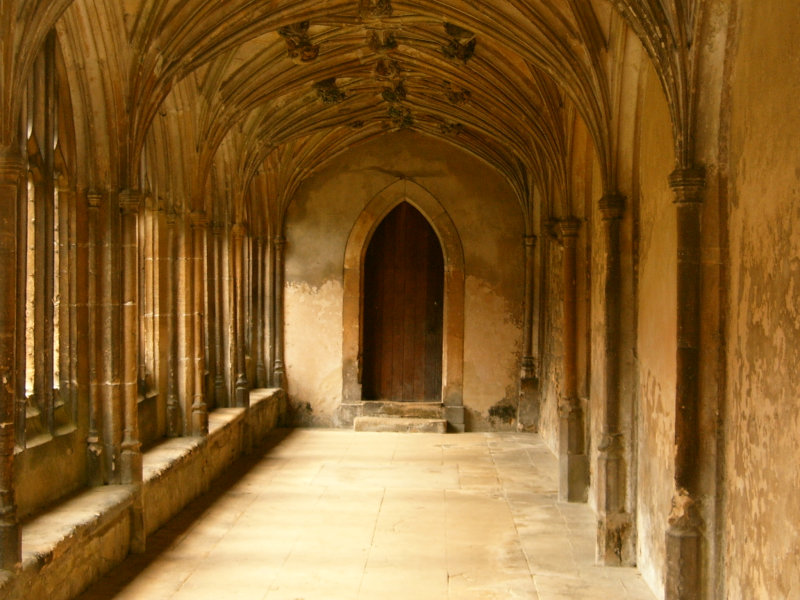
Looks like they are headed by to Lacock Abbey in October to shoot night scenes of the next film in the Harry Potter series, The Half Blood Prince (and we know who that is!). What is Lacock Abbey? Here's what Wiki has to say:

Lacock Abbey in the village of Lacock, Wiltshire, England, was founded in the early 13th century by Ela, Countess of Salisbury, as a nunnery of the Augustinian order.

Lacock Abbey was founded by Lady Ela the Countess of Salisbury in the reign of King Henry III. Her husband was William Longespee, an illegitimate son of King Henry II. Generally, Lacock Abbey prospered throughout the Middle Ages. The rich farmlands which it had received from Ela ensured it a sizeable income from wool.

Following the Dissolution of the Monasteries in the mid-16th century, Henry VIII of England sold it to Sir William Sharrington, who converted it into a house starting in 1539, demolishing the abbey church. Few other alterations were made to the monastic buildings themselves: the cloisters, for example, still stand...
Here's what the Leaky Cauldron has to say:
Due to take place sometime in October, HBP crews will film for four days and film scenes between 5pm and 5am. The paper reports that “High Street and Church Street will be closed and the bus stop outside the George Inn looks set to be relocated for the duration.” Readers will remember that the Cloisters of this Abbey were used in “Chamber of Secrets,” famously for the "Dobby is Free" scene.
Ah yes, "Dobby is free."

Tuesday, August 21, 2007

And all shall be well and
All manner of thing shall be well
When the tongues of flame are in-folded
Into the crowned knot of fire
And the fire and the rose are one.

TS Eliot, Four Quartets

Friday, August 17, 2007

Monday, August 13, 2007


NOTE: Christopher Hitchens writes a review of Deathly Hallows for the New York Times. We know something is amiss when he recommends Philip Pullman over J.K. Rowling.

August 12, 2007

The Boy Who Lived

HARRY POTTER AND THE DEATHLY HALLOWS

By J. K. Rowling. Illustrated by Mary GrandPré.

759 pp. Arthur A. Levine Books/Scholastic. $34.99.

In March 1940, in the “midnight of the century” that marked the depth of the Hitler-Stalin pact (or in other words, at a time when civilization was menaced by an alliance between two Voldemorts or “You-Know-Whos”), George Orwell took the time to examine the state of affairs in fantasy fiction for young people. And what he found (in an essay called “Boys’ Weeklies”) was an extraordinary level of addiction to the form of story that was set in English boarding schools. Every week, boys (and girls) from the poorer quarters of industrial towns and from the outer edges of the English-speaking Empire would invest some part of their pocket-money to keep up with the adventures of Billy Bunter, Harry Wharton, Bob Cherry, Jack Blake and the other blazer-wearing denizens of Greyfriars and St. Jim’s. As he wrote:

“It is quite clear that there are tens and scores of thousands of people to whom every detail of life at a ‘posh’ public school is wildly thrilling and romantic. They happen to be outside that mystic world of quadrangles and house-colors, but they can yearn after it, daydream about it, live mentally in it for hours at a stretch. The question is, Who are these people?”

I wish that the morose veteran of Eton and St. Cyprian’s had been able to join me on the publication night of “Harry Potter and the Deathly Hallows,” when I went to a bookstore in Stanford, Calif., to collect my embargoed copy on behalf of the Book Review. Never mind the stall that said “Get Your House Colors Here” and was dealing with customers wise in the lore of Ravenclaw and Slytherin. On the floor of the shop, largely transformed into the Gryffindor common room for the occasion, sat dozens of small children listening raptly to a reading from a massively plausible Hagrid. Of the 2,000 or so people in the forecourt, perhaps one-third had taken the trouble to wear prefect gowns and other Hogwarts or quidditch impedimenta. Many wore a lightning-flash on their foreheads: Orwell would have recoiled at seeing the symbol of Sir Oswald Mosley’s British Union of Fascists on otherwise unblemished brows, even if the emblem was tamed by its new white-magic associations. And this was a sideshow to the circus, all across the English-speaking and even non-English world, as the countdown to the witching hour began.

I would give a lot to understand this phenomenon better. Part of it must have to do with the extreme banality and conformity of school life as it is experienced today, with everything oriented toward safety on the one hand and correctness on the other. But this on its own would not explain my youngest daughter a few years ago, sitting for hours on end with her tiny elbow flattening the pages of a fat book, and occasionally laughing out loud at the appearance of Scabbers the rat. (One hears that not all children retain the affection for reading that the Harry Potter books have inculcated: this isn’t true in my house at least.)

Scabbers turns out to mutate into something a bit worse than a rat, and the ancient charm of metamorphosis is one that J. K. Rowling has exploited to the uttermost. Another well-tested appeal, that of the orphan hero, has also been given an intensive workout with the Copperfield-like privations of the eponymous hero. For Orwell, the English school story from Tom Brown to Kipling’s Stalky and Co. was intimately bound up with dreams of wealth and class and snobbery, yet Rowling has succeeded in unmooring it from these considerations and giving us a world of youthful democracy and diversity, in which the humble leading figure has a name that — though it was given to a Shakespearean martial hero and king — could as well belong to an English labor union official. Perhaps Anglophilia continues to play its part, but if I were one of the few surviving teachers of Anglo-Saxon I would rejoice at the way in which such terms as muggle and Wizengamot, and such names as Godric, Wulfric and Dumbledore, had become common currency. At this rate, the teaching of “Beowulf” could be revived. The many Latin incantations and imprecations could also help rekindle interest in the study of a “dead” language.

In other respects, too, one recognizes the school story formula. If a French or German or other “foreign” character appears in the Harry Potter novels, it is always as a cliché: Fleur and Krum both speak as if to be from “the Continent” is a joke in itself. The ban on sexual matters is also observed fairly pedantically, though as time has elapsed Rowling has probably acquired male readers who find themselves having vaguely impure thoughts about Hermione Granger (if not, because the thing seems somehow impossible, about Ginny Weasley). Most interesting of all, perhaps, and as noted by Orwell, “religion is also taboo.” The schoolchildren appear to know nothing of Christianity; in this latest novel Harry and even Hermione are ignorant of two well-known biblical verses encountered in a churchyard. That the main characters nonetheless have a strong moral code and a solid ethical commitment will be a mystery to some — like his holiness the pope and other clerical authorities who have denounced the series — while seeming unexceptionable to many others. As Hermione phrases it, sounding convincingly Kantian or even Russellian about something called the Resurrection Stone:

“How can I possibly prove it doesn’t exist? Do you expect me to get hold of — of all the pebbles in the world and test them? I mean, you could claim that anything’s real if the only basis for believing in it is that nobody’s proved it doesn’t exist.”

For all this apparently staunch secularism, it is ontology that ultimately slackens the tension that ought to have kept these tales vivid and alive. Theologians have never been able to answer the challenge that contrasts God’s claims to simultaneous omnipotence and benevolence: whence then cometh evil? The question is the same if inverted in a Manichean form: how can Voldemort and his wicked forces have such power and yet be unable to destroy a mild-mannered and rather disorganized schoolboy? In a short story this discrepancy might be handled and also swiftly resolved in favor of one outcome or another, but over the course of seven full-length books the mystery, at least for this reader, loses its ability to compel, and in this culminating episode the enterprise actually becomes tedious. Is there really no Death Eater or dementor who is able to grasp the simple advantage of surprise?

The repeated tactic of deus ex machina (without a deus) has a deplorable effect on both the plot and the dialogue. The need for Rowling to play catch-up with her many convolutions infects her characters as well. Here is Harry trying to straighten things out with a servile house-elf:

“ ‘I don’t understand you, Kreacher,’ he said finally. ‘Voldemort tried to kill you, Regulus died to bring Voldemort down, but you were still happy to betray Sirius to Voldemort? You were happy to go to Narcissa and Bellatrix, and pass information to Voldemort through them ...’ ”

Yes, well, one sees why he is confused. The exchange takes place during an abysmally long period during which the threesome of Harry, Hermione and Ron are flung together, with weeks of time to spend camping invisibly and only a few inexplicable escapes from death to alleviate the narrative. The grand context of Hogwarts School is removed, at least until the closing scenes, and Rowling also keeps forgetting that things are either magical or they are not: Hermione’s family surely can’t be any safer from the Dark Lord by moving to Australia, and Hagrid’s corporeal bulk cannot make any difference to his ability, or otherwise, to mount a broomstick. A boring subtext, about the wisdom or otherwise of actually uttering Voldemort’s name, meanwhile robs the apotropaic device of its force.

For some time now the novels have been attempting a kind of secular dramatization of the battle between good and evil. The Ministry of Magic (one of Rowling’s better inventions) has been seeking to impose a version of the Nuremberg Laws on England, classifying its subjects according to blood and maintaining its own Gestapo as well as its own Azkaban gulag. But again, over time and over many, many pages this scenario fails to chill: most of the “muggle” population goes about its ordinary existence, and every time the secret police close in, our heroes are able to “disapparate” — a term that always makes me think of an attempt at English by George W. Bush. The prejudice against bank-monopoly goblins is modeled more or less on anti-Semitism and the foul treatment of elves is meant to put us in mind of slavery, but the overall effect of this is somewhat thin and derivative, and subject to diminishing returns.

In this final volume there is a good deal of loose-end gathering to be done. Which side was Snape really on? Can Neville Longbottom rise above himself? Are the Malfoys as black as they have been painted? Unfortunately — and with the solid exception of Neville, whose gallantry is well evoked — these resolutions prove to possess all the excitement of an old-style Perry Mason-type summing-up, prompted by a stock character who says, “There’s just one thing I don’t understand. ...” Most of all this is true of Voldemort himself, who becomes more tiresome than an Ian Fleming villain, or the vicious but verbose Nicolae Carpathia in the Left Behind series, as he offers boastful explanations that are at once grandiose and vacuous. This bad and pedantic habit persists until the final duel, which at least sees us back in the old school precincts once again. “We must not let in daylight upon magic,” as Walter Bagehot remarked in another connection, and the wish to have everything clarified is eventually self-defeating in its own terms. In her correct determination to bring down the curtain decisively, Rowling has gone further than she should, and given us not so much a happy ending as an ending which suggests that evil has actually been defeated (you should forgive the expression) for good.

Greater authors — Arthur Conan Doyle most notably — have been in the same dilemma when seeking closure. And, like Conan Doyle, Rowling has won imperishable renown for giving us an identifiable hero and a fine caricature of a villain, and for making a fictional bit of King’s Cross station as luminous as a certain address on nearby Baker Street. It is given to few authors to create a world apart, and to populate it as well as illustrate it in the mind. As one who actually did once go to boarding school by steam train, at 8, I enjoyed reading aloud to children and coming across Diagon Alley and Grimmauld Place, and also shuddering at the memory of the sarcastic schoolmasters (and Privet Drives) I have known.

The distinctly slushy close of the story may seem to hold out the faint promise of a sequel, but I honestly think and sincerely hope that this will not occur. The toys have been put firmly back in the box, the wand has been folded up, and the conjuror is discreetly accepting payment while the children clamor for fresh entertainments. (I recommend that they graduate to Philip Pullman, whose daemon scheme is finer than any patronus.) It’s achievement enough that “19 years later,” as the last chapter-heading has it, and quite probably for many decades after that, there will still be millions of adults who recall their initiation to literature as a little touch of Harry in the night.

Christopher Hitchens is a columnist for Vanity Fair. His most recent book is “God Is Not Great: How Religion Poisons Everything.”

Friday, August 10, 2007

Review by the author Stephen King from Entertainment Weekly.

And so now the hurly-burly's done, the battle's lost and won — the Battle of Hogwarts, that is — and all the secrets are out of the Sorting Hat. Those who bet Harry Potter would die lost their money; the boy who lived turned out to be exactly that. And if you think that's a spoiler at this late date, you were never much of a Potter fan to begin with. The outrage over the early reviews (Mary Carole McCauley of The Baltimore Sun, Michiko Kakutani of The New York Times) has faded...although the sour taste lingers for many fans.

It lingers for me, too, although it doesn't have anything to do with the ultimately silly concept of ''spoilers,'' or the ethics of jumping the book's pub date. The prepublication vow of omertà was, after all, always a thing concocted by publishers Bloomsbury and Scholastic, and not — so far as I know — a part of either the British Magna Carta or the U.S. Constitution. Nor does Jo Rowling's impassioned protest (''I am staggered that some American newspapers have decided to publish...reviews in complete disregard of the wishes of literally millions of readers, particularly children...'') cut much ice with me. These books ceased to be specifically for children halfway through the series; by Goblet of Fire, Rowling was writing for everyone, and knew it.

The clearest sign of how adult the books had become by the conclusion arrives — and splendidly — in Deathly Hallows, when Mrs. Weasley sees the odious Bellatrix Lestrange trying to finish off Ginny with a Killing Curse. ''NOT MY DAUGHTER, YOU BITCH!'' she cries. It's the most shocking bitch in recent fiction; since there's virtually no cursing (of the linguistic kind, anyway) in the Potter books, this one hits home with almost fatal force. It is totally correct in its context — perfect, really — but it is also a quintessentially adult response to a child's peril.

The problem with the advance reviews — and those that followed in the first post-publication days — is one that has dogged Rowling's magnum opus ever since book 4 (Goblet of Fire), after the series had become a worldwide phenomenon. Due to the Kremlin-like secrecy surrounding the books, all reviews since 2000 or so have been strictly shoot-from-the-lip. The reviewers themselves were often great — Ms. Kakutani ain't exactly chopped liver — but the very popularity of the books has often undone even the best intentions of the best critical writers. In their hurry to churn out column inches, and thus remain members of good standing in the Church of What's Happening Now, very few of the Potter reviewers have said anything worth remembering. Most of this microwaved critical mush sees Harry — not to mention his friends and his adventures — in only two ways: sociologically (''Harry Potter: Boon or Childhood Disease?'') or economically (''Harry Potter and the Chamber of Discount Pricing''). They take a perfunctory wave at things like plot and language, but do little more...and really, how can they? When you have only four days to read a 750-page book, then write an 1,100-word review on it, how much time do you have to really enjoy the book? To think about the book? Jo Rowling set out a sumptuous seven-course meal, carefully prepared, beautifully cooked, and lovingly served out. The kids and adults who fell in love with the series (I among them) savored every mouthful, from the appetizer (Sorcerer's Stone) to the dessert (the gorgeous epilogue of Deathly Hallows). Most reviewers, on the other hand, bolted everything down, then obligingly puked it back up half-digested on the book pages of their respective newspapers.

And because of that, very few mainstream writers, from Salon to The New York Times, have really stopped to consider what Ms. Rowling has wrought, where it came from, or what it may mean for the future. The blogs, by and large, haven't been much better. They seem to care about who lives, who dies, and who's tattling. Beyond that, it's all pretty much duh.

So what did happen? Where did this Ministry of Magic come from?

Well, there were straws in the wind. While the academics and bighead education critics were moaning that reading was dead and kids cared about nothing but their Xboxes, iPods, Avril Lavigne, and High School Musical, the kids they were worried about were quietly turning on to the novels of one Robert Lawrence Stine. Known in college as ''Jovial Bob'' Stine, this fellow gained another nickname later in life, as — ahem — ''the Stephen King of children's literature.'' He wrote his first teen horror novel (Blind Date) in 1986, years before the advent of Pottermania...but soon you couldn't glance at a USA Today best-seller list without seeing three or four of his paperbacks bobbing around in the top 50.

These books drew almost no critical attention — to the best of my knowledge, Michiko Kakutani never reviewed Who Killed the Homecoming Queen? — but the kids gave them plenty of attention, and R.L. Stine rode a wave of kid popularity, partly fueled by the fledgling Internet, to become perhaps the best-selling children's author of the 20th century. Like Rowling, he was a Scholastic author, and I have no doubt that Stine's success was one of the reasons Scholastic took a chance on a young and unknown British writer in the first place. He's largely unknown and uncredited...but of course John the Baptist never got the same press as Jesus either.

Rowling has been far more successful, critically as well as financially, because the Potter books grew as they went along. That, I think, is their great secret (and not so secret at that; to understand the point visually, buy a ticket to Order of the Phoenix and check out former cutie Ron Weasley towering over Harry and Hermione). R.L. Stine's kids are kids forever, and the kids who enjoyed their adventures grew out of them, as inevitably as they outgrew their childhood Nikes. Jo Rowling's kids grew up...and the audience grew up with them.

This wouldn't have mattered so much if she'd been a lousy writer, but she wasn't — she was and is an incredibly gifted novelist. While some of the blogs and the mainstream media have mentioned that Rowling's ambition kept pace with the skyrocketing popularity of her books, they have largely overlooked the fact that her talent also grew. Talent is never static, it's always growing or dying, and the short form on Rowling is this: She was far better than R.L. Stine (an adequate but flavorless writer) when she started, but by the time she penned the final line of Deathly Hallows (''All was well.''), she had become one of the finer stylists in her native country — not as good as Ian McEwan or Ruth Rendell (at least not yet), but easily the peer of Beryl Bainbridge or Martin Amis.

And, of course, there was the magic. It's what kids want more than anything; it's what they crave. That goes back to the Brothers Grimm, Hans Christian Andersen, and good old Alice, chasing after that wascally wabbit. Kids are always looking for the Ministry of Magic, and they usually find it.

One day in my hometown of Bangor, I was walking up the street and observed a dirty-faced boy of about 3 with scabbed knees and a look of extreme concentration on his face. He was sitting on the dirt strip between the sidewalk and the asphalt. He had a stick in his hand and kept jabbing it into the dirt. ''Get down there!'' he cried. ''Get down there, dammit! You can't come out until I say the Special Word! You can't come out until I say so!''

Several people passed by the kid without paying much attention (if any). I slowed, however, and watched as long as I could — probably because I have spent so much time telling the things inhabiting my own imagination to get back down and not come out until I say so. I was charmed by the kid's effortless make-believe (always assuming it was make-believe, heh-heh-heh). And a couple of things occurred to me. One was that if he had been an adult, the cops would have taken him away either to the drunk tank or to our local Dreamboat Manor for a psychiatric exam. Another was that kids exhibiting paranoid-schizophrenic tendencies are simply accepted in most societies. We all understand that kids are crazy until they hit 8 or so, and we cut their groovy, anything-goes minds some slack.

This happened around 1982, while I was getting ready to write a long story about children and monsters (It), and it influenced my thinking on that novel a great deal. Even now, years later, I think of that kid — a little Minister of Magic using a dead twig for a wand — with affection, and hope he didn't consider himself too old for Harry Potter when those books started appearing. He might have; sad to think so, but one thing J.R.R. Tolkien acknowledges that Rowling doesn't is that sometimes — often, really — the magic goes away.

It was children whom Ms. Rowling — like her Fear Street precursor, but with considerably more skill — captivated first, demonstrating with the irrefutable logic of something like 10 bazillion books sold that kids are still perfectly willing to put aside their iPods and Game Boys and pick up a book...if the magic is there. That reading itself is magical is a thing I never doubted. I'd give a lot to know how many teenagers (and preteens) texted this message in the days following the last book's release: DON'T CALL ME TODAY I'M READING.

The same thing probably happened with R.L. Stine's Goosebumps books, but unlike Stine, Rowling brought adults into the reading circle, making it much larger. This is hardly a unique phenomenon, although it seems to be one associated mainly with British authors (there was Huckleberry Finn, of course, a sequel to its YA little brother Tom Sawyer). Alice in Wonderland began as a story told to 10-year-old Alice Liddell by Charles Dodgson (a.k.a. Lewis Carroll); it is now taught in college lit courses. And Watership Down, Richard Adams' version of The Odyssey (featuring rabbits instead of humans), began as a story told to amuse the author's preteen daughters, Juliet and Rosamond, on a long car drive. As a book, though, it was marketed as an ''adult fantasy'' and became an international best-seller.

Maybe it's the British prose. It's hard to resist the hypnotism of those calm and sensible voices, especially when they turn to make-believe. Rowling was always part of that straightforward storytelling tradition (Peter Pan, originally a play by the Scot J.M. Barrie, is another case in point). She never loses sight of her main theme — the power of love to turn bewildered, often frightened, children into decent and responsible adults — but her writing is all about story. She's lucid rather than luminous, but that's okay; when she does express strong feelings, she remains their mistress without denying their truth or power. The sweetest example in Deathly Hallows comes early, with Harry remembering his childhood years in the Dursley house. ''It gave him an odd, empty feeling to remember those times,'' Rowling writes. ''[I]t was like remembering a younger brother whom he had lost.'' Honest; nostalgic; not sloppy. It's a small example of the style that enabled Jo Rowling to bridge the generation gap without breaking a sweat or losing the cheerful dignity that is one of the series' great charms.

Her characters are lively and well-drawn, her pace is impeccable, and although there are occasional continuity drops, the story as a whole hangs together almost perfectly over its 4,000-plus page length.

And she's in full possession of that famously dry British wit, as when Ron, trying to tune in an outlaw news broadcast on his wizard radio, catches a snatch of a pop song called ''A Cauldron Full of Hot Strong Love.'' Must have been some witchy version of Donna Summer doing that one. There's also her wry send-up of the British tabloids — about which I'm sure she knows plenty — in the person of Rita Skeeter, perhaps the best name to be hung on a fictional character since those of Jonathan Swift. When Elphias Doge, the perfect magical English gentleman, calls Rita ''an interfering trout,'' I felt like standing up and giving a cheer. Take that, Page Six! There's a lot of meat on the bones of these books — good writing, honest feeling, a sweet but uncompromising view of human nature...and hard reality: NOT MY DAUGHTER, YOU BITCH! The fact that Harry attracted adults as well as children has never surprised me.

Are the books perfect? Indeed not. Some sections are too long. In Deathly Hallows, for instance, there's an awful lot of wandering around and camping in that tent; it starts to feel like Ms. Rowling running out the clock on the school year to fit the format of the previous six books.

And sometimes she falls prey to the Robinson Crusoe syndrome. In Crusoe, whenever the marooned hero requires something, he ventures out to his ship — which has conveniently run aground on the reef surrounding his desert island — and takes what he needs from stores (in one of the most amusing continuity flubs in the history of English literature, Robinson once swims out naked...then fills his pockets). In much the same manner, whenever Harry and his friends get into a tight corner, they produce some new spell — fire, water to douse the fire, stairs that conveniently turn into a slide — and squiggle free. I accepted most of these, partly because there's enough child in me to react gleefully rather than doubtfully (in a way, the Potter books are The Joy of Magic rather than The Joy of Cooking) but also because I understand that magic is its own thing, and probably boundless. Still, by the time the Battle of Hogwarts was reaching its climax of clumping giants, cheering portraits, and flying wizards, I almost longed for someone to pull out a good old MAC-10 and start blasting away like Rambo.

If all those creative spells — produced at the right moment like the stuff from Crusoe's ship — were a sign of creative exhaustion, it's the only one I saw, and that's pretty amazing. Mostly Rowling is just having fun, knocking herself out, and when a good writer is having fun, the audience is almost always having fun too. You can take that one to the bank (and, Reader, she did).

One last thing: The bighead academics seem to think that Harry's magic will not be strong enough to make a generation of nonreaders (especially the male half) into bookworms...but they wouldn't be the first to underestimate Harry's magic; just look at what happened to Lord Voldemort. And, of course, the bigheads would never have credited Harry's influence in the first place, if the evidence hadn't come in the form of best-seller lists. A literary hero as big as the Beatles? ''Never happen!'' the bigheads would have cried. ''The traditional novel is as dead as Jacob Marley! Ask anyone who knows! Ask us, in other words!''

But reading was never dead with the kids. Au contraire, right now it's probably healthier than the adult version, which has to cope with what seems like at least 400 boring and pretentious ''literary novels'' each year. While the bigheads have been predicting (and bemoaning) the postliterate society, the kids have been supplementing their Potter with the narratives of Lemony Snicket, the adventures of teenage mastermind Artemis Fowl, Philip Pullman's challenging His Dark Materials trilogy, the Alex Rider adventures, Peter Abrahams' superb Ingrid Levin-Hill mysteries, the stories of those amazing traveling blue jeans. And of course we must not forget the unsinkable (if sometimes smelly) Captain Underpants. Also, how about a tip of the old tiara to R.L. Stine, Jo Rowling's jovial John the Baptist?

I began by quoting Shakespeare; I'll close with the Who: The kids are alright. Just how long they stay that way sort of depends on writers like J.K. Rowling, who know how to tell a good story (important) and do it without talking down (more important) or resorting to a lot of high-flown gibberish (vital). Because if the field is left to a bunch of intellectual Muggles who believe the traditional novel is dead, they'll kill the damn thing.

It's good make-believe I'm talking about. Known in more formal circles as the Ministry of Magic. J.K. Rowling has set the standard: It's a high one, and God bless her for it.

Monday, July 30, 2007


Rough transcript of Jo Rowling's webchat here. Full version will be put up here on Tuesday.

More than 120,000 questions were sent in for today's webchat and as it’s the first time J.K. Rowling has been able to answer questions so freely.

J.K. Rowling: I’m here and I can’t wait! Bring on the questions!

Leaky Cauldron: What, if anything, did the wizarding world learn, and how did society change, as a direct result of the war with voldemort? (i.E., not as a result of harry, ron and hermione’s future careers.)

J.K. Rowling: The Ministry of Magic was de-corrupted, and with Kingsley at the helm the discrimination that was always latent there was eradicated.

J.K. Rowling: Harry, Ron, Hermione, Ginny et al would of course play a significant part in the re-building of wizarding society through their future careers.

Ryan Love: From your fans at thesnitch.Co.Uk. Weren’t we supposed to see ginny display powerful magical abilities in “deathly hallows” and find out why it’s significant that she’s the seventh child? Was her main role in the books only to be harry’s love interest?

J.K. Rowling: Hi Ryan! Well, I think Ginny demonstrated powerful magic in the final battle, and that for a sixteen year old witch she acquitted herself pretty well. I don’t remember ever saying that her ‘seventh child’ status would prove particularly

J.K. Rowling: important in the last book, though – are you sure I said that?!

J.K. Rowling: No, the Malfoys weaseled their way out of trouble (again) due to the fact that they colluded (albeit out of self-interest) with Harry at the end of the battle. Georgina: Did lucius malfoy, and all the other escaped death eaters, go back to azkaban

Elisabeth: In the chapter of kings cross, are they behind the veil or in some world between the real world and the veil?

J.K. Rowling: You can make up your own mind on this, but I think that Harry entered a kind of limbo between life and death.

Renee: From reading about the original owners of the deathly hallows, the peverell brothers, i’m wondering if harry and voldermort are distantly related voldermorts grandfather ended up with the resurrection stone ring?

J.K. Rowling: Yes, Harry and Voldemort are distantly related through the Peverells.

J.K. Rowling: Of course, nearly all wizarding families are related if you trace them back through the centuries. As was made clear in ‘Deathly hallows’, Peverell blood would run through many wizarding families.

Fomy: What did you feel when you finally wrote the kiss, awaited so much by the fans, of ron and hermione

J.K. Rowling: I loved writing it, and I loved the fact that Hermione took the initiative!

J.K. Rowling: Ron had finally got SPEW and earned himself a snog!

Angela Morrissey: Why is it that albus dumbledore can see harry under his invisibility cloak at certain moments? (during the series is the cloak only infallible to those who do not own a deathly hallow).

J.K. Rowling: Dumbledore, who could perform magic without needing to say the incantation aloud, was using ‘homenum revelio’ -

J.K. Rowling: – the human-presence-revealing spell Hermione makes use of in Deathly Hallows.

Jamie Lewis: What ever happened to winky

J.K. Rowling: She’s still at Hogwarts, and she was one of the oncoming house-elves who attacked the Death Eaters in the final battle.

Katieleigh: Does hermione still continue to do work with spew and is life any better for house elves!

J.K. Rowling: Hermione began her post-Hogwarts career at the Department for the Regulation and Control of Magical Creatures

J.K. Rowling: where she was instrumental in greatly improving life for house-elves and their ilk. She then moved (despite her jibe to Scrimgeour) to the Dept. of Magical Law Enforcement

J.K. Rowling: where she was a progressive voice who ensured the eradication of oppressive, pro-pureblood laws.

Tineke: Did teddy grow up living with his grandmother?

J.K. Rowling: Yes, Teddy was raised by Andromeda.

J.K. Rowling: However, unlike Neville, who was also raised by his grandmother

J.K. Rowling: Teddy had his godfather, Harry, and all his father’s friends in the Order, to visit and stay with.

Blodeuwedd: Hi jk, first of all thank you for all the books I have enjoyed each and every one of them could you tell us what professions harry, hermione, ron, ginny and luna go on to have did the trio do their final year at school and take their newts who became hea

J.K. Rowling: Harry did so (just because Voldemort was gone, it didn’t mean that there would not be other Dark witches and wizards in the coming years).

J.K. Rowling: Ron joined George at Weasleys’ Wizarding Wheezes, which became an enormous money-spinner..

J.K. Rowling: After a few years as a celebrated player for the Holyhead Harpies, Ginny retired to have her family and to become the Senior Quidditch correspondent at the Daily Prophet!

Camille: What or who is peeves exactly, is he linked with the blood barons story?

J.K. Rowling: Thank you! I’ve already answered about Hermione. Kingsley became permanent Minister for Magic, and naturally he wanted Harry to head up his new Auror department.

Camille: What or who is peeves exactly, is he linked with the blood barons story?

J.K. Rowling: No, Peeves is not linked to the bloody Baron’s story.

J.K. Rowling: He is a spirit of chaos that entered the building long ago and has proved impossible to eradicate!

Jessie: Were the deathly hallows based on any realworld myth or faerie tale

J.K. Rowling: Perhaps ‘the Pardoner’s Tale’, by Chaucer.

Alicepie: What happend to luna, did she get married who to?

J.K. Rowling: She ended up marrying (rather later than Harry & co) a fellow naturalist and grandson of the great Newt Scamander (Rolf)!

Rosi: What does in essence divided mean?

J.K. Rowling: Dumbledore suspected that the snake’s essence was divided – that it contained part of Voldemort’s soul, and that was why it was so very adept at doing his bidding.

J.K. Rowling: This also explained why Harry, the last and unintended Horcrux, could see so clearly through the snake’s eyes, just as he regularly sees through Voldemort’s.

J.K. Rowling: Dumbledore is thinking aloud here, edging towards the truth with the help of the Pensieve.

Superhans: What was duldeys worst memory?

J.K. Rowling: I think that when Dudley was attacked by the Dementors he saw himself, for the first time, as he really was. This was an extremely painful, but ultimately salutory lesson, and began the transformation in him.

Superhans: What was duldeys worst memory?

J.K. Rowling: I think that when Dudley was attacked by the Dementors he saw himself, for the first time, as he really was. This was an extremely painful, but ultimately salutory lesson, and began the transformation in him.

Casey Kunze: Who killed remus and tonks I think if I knew this, I would get some closure over the very sad, but understandable, death of two of my favorite characters

J.K. Rowling: I’m so sorry! I met a couple on launch night who had come dressed as Lupin and Tonks, and I felt dreadfully guilty as I signed their books!

J.K. Rowling: Remus was killed by Dolohov and Tonks by Bellatrix.

Laura Trego: Was the absence of snapes portrait in the headmasters office in the last scene innocent or deliberate

J.K. Rowling: It was deliberate. Snape had effectively abandoned his post before dying, so he had not merited inclusion in these august circles.

J.K. Rowling: However, I like to think that Harry would be instrumental in ensuring that Snape’s portrait would appear there in due course.

Stephanie: If the wand chooses the wizard, then why do wands work when passed down from father to son eg neville had his fathers wand

J.K. Rowling: As established by Ollivander, a wizard can use almost any wand, it is simply that a wand that chooses him/her will work best. Where there is a family connection, a wand will work a little better than a wand chosen at random, I think.

James Farrell: How did umbridge manage to conjure a patronus while wearing the locket when harry wasnt able to

J.K. Rowling: Because she is a very nasty piece of work. She has an affinity for this horrible object, which would help rather than hinder her.

Tineke: What happened to percy did he return to his job at the ministry

J.K. Rowling: Yes, the new improved Percy ended up as a high-ranking official under Kingsley.

Su: How did neville get the gryfindor sword, is there a link to the hat

J.K. Rowling: Yes, there is very definitely a link to the hat!

J.K. Rowling: Neville, most worthy Gryffindor, asked for help just as Harry did in the Chamber of secrets, and Gryffindor’s sword was transported into Gryffindor’s old hat

J.K. Rowling: – the Sorting Hat was Gryffindor’s initially, as you know.

J.K. Rowling: Griphook was wrong – Gryffindor did not ‘steal’ the sword, not unless you are a goblin fanatic and believe that all goblin-made objects really belong to the maker.

Steph: Will azkaban still use dementors?

J.K. Rowling: No, definitely not. Kingsley would see to that. The use of Dementors was always a mark of the underlying corruption of the Ministry, as Dumbledore constantly maintained.

Smallbutpowerful: On behalf of all harry potter fans who consider themselves to be hufflepuffs could you please describe the hufflepuff common room as it is the only common room harry hasn’t visited

J.K. Rowling: The Hufflepuff common room is accessed through a portrait near the kitchens, as I am sure you have deduced.

J.K. Rowling: Sorry – I should say ‘painting’ rather than portrait, because it is a still-life.

J.K. Rowling: It is a very cosy and welcoming place, as dissimilar as possible from Snape’s dungeon. Lots of yellow hangings, and fat armchairs, and little underground tunnels leading to the dormitories, all of which have perfectly round doors, like barrel tops.

Camille: How is george getting along without his twin

J.K. Rowling: Well, I don’t think that George would ever get over losing Fred, which makes me feel so sad. However, he names his first child and son Fred, and he goes on to have a very successful career, helped by good old Ron.

Jessica Lynn: Did hagrid have to be able to see thestrals in order to train them if so, whose death did hagrid witness

J.K. Rowling: Hagrid has seen many deaths in quite a long life, so yes, he can see Thestrals.

Allie: What did dumbledore truly see in the mirror of erised

J.K. Rowling: He saw his family alive, whole and happy – Ariana, Percival and Kendra all returned to him, and Aberforth reconciled to him.

Snapedinhalf: You promised that someone will do magic late in life in book 7. I’ve now read it three times but cant work out who it might have been! Please help!!

J.K. Rowling: I’m sorry about this, but I changed my mind!

J.K. Rowling: My very earliest plan for the story involved somebody managing to get to Hogwarts when they had never done magic before, but I had changed my mind by the time I’d written the third book.

Christiana: How did voldemort get his wand back after he was in was exile

J.K. Rowling: Wormtail, desperate to curry favour, salvaged it from the place it had fallen and carried it to him. I admit that would have been a bit of a feat for a rat, but they are highly intelligent creatures!

Amanda: Hiya, ive grown up with harry and the gang, did any of the characters change in any unexpected ways as they grew up

J.K. Rowling: They all became pretty much what I expected/planned them to become.

J.K. Rowling: Of course they changed as I wrote, but nobody surprised me very much!

Ravleen: How much does the fact that voldemort was conceived under a love potion have to do with his nonability to understand love is it more symbolic

J.K. Rowling: It was a symbolic way of showing that he came from a loveless union – but of course, everything would have changed if Merope had survived and raised him herself and loved him.

J.K. Rowling: The enchantment under which Tom Riddle fathered Voldemort is important because it shows coercion, and there can’t be many more prejudicial ways to enter the world than as the result of such a union.

Lechicaneuronline: Do you think snape is a hero

J.K. Rowling: Yes, I do; though a very flawed hero. An anti-hero, perhaps. He is not a particularly likeable man in many ways. He remains rather cruel, a bully, riddled with bitterness and insecurity – and yet he loved, and showed loyalty to that love

J.K. Rowling: and, ultimately, laid down his life because of it. That’s pretty heroic!

James Farrell: Voldemort never told anyone about his horcruxes, so how on earth did regulus black discover his secret

J.K. Rowling: Horcrux magic was not Voldemort’s own invention; as is established in the story, other wizards had done it, though never gone as far as to make six.

J.K. Rowling: Voldemort dropped oblique hints; in his arrogance, he did not believe anybody would be clever enough to understand them.

J.K. Rowling: (He does so in the graveyard of Little Hangleton, in front of Harry). He did this before Regulus and Regulus guessed, correctly, what it was that made Voldemort so convinced he could not die.

Jaclyn: Did lily ever have feelings back for snape

J.K. Rowling: Yes. She might even have grown to love him romantically (she certainly loved him as a friend) if he had not loved Dark Magic so much, and been drawn to such loathesome people and acts.

Boggo: Would you choose the hallow that is the cloak, like youre supposed to, and would you be tempted to use the others

J.K. Rowling: My temptation would be Harry’s, ie, the Stone. But I believe, as does Harry ultimately, that the greatest wisdom is in accepting that we must all die, and moving on.

Cornersoul: So what happens to all the dementors where will they go will they be destroyed if so, how

J.K. Rowling: You cannot destroy Dementors, though you can limit their numbers if you eradicate the conditions in which they multiply, ie, despair and degradation. As I’ve already said, though,

J.K. Rowling: the Ministry no longer used them to torment its opponents.

Michael: Why didnt fawkes come back to help harry I would have thought that since harry was so loyal to dumbledore, fawkes would have been harrys new pet

J.K. Rowling: Something had to leave the school for good when Dumbledore died, and I decided that would be Fawkes. Dumbledore was a very great and irreplacable man, and the loss of Fawkes (and the fact that he was ‘non-transferable’!) expresses this symbolically

Roseweasley: Why was colin creavey still a student at hogwarts when he was muggleborn surely he would have been locked up and interogated, not allowed back to school therefore, he shouldnt have died

J.K. Rowling: Colin wasn’t a student. He sneaked back with the rest of the DA, along with Fred, George and the rest. He ought not to have stayed behind when McGonagall told him to leave, but alas – he did.

Delailah: How does dumbledore understand parseltongue?

J.K. Rowling: Dumbledore understood Mermish, Gobbledegook and Parseltongue. The man was brilliant.

Jessie: Will lockhart ever recover?

J.K. Rowling: No. Nor would I want him to. He’s happy where he is, and I’m happier without him!

Annie: Does the wizarding world now know that snape was dumbledores man, or do they still think he did a bunk

J.K. Rowling: Harry would ensure that Snape’s heroism was known.

J.K. Rowling: Of course, that would not stop Rita Skeeter writing ‘Snape: Scoundrel or Saint?’

Vio91: Is teddy lupin a werewolf

J.K. Rowling: No, he’s a Metamorphmagus like his mother

Nippy23: We see socks a lot throughout the series, such as dobby’s love for them and dumbledore’s claim to see them in the mirror of erised, what’s the reason behind all the socks

J.K. Rowling: Nothing deep and significant, I’m afraid. They’re just a comedy item.

Lady Bella: Whose murders did voldemor use to create each of the horcruxes

J.K. Rowling: The diary – Moaning Myrtle. The cup – Hepzibah Smith, the previous owner. The locket – a Muggle tramp. Nagini – Bertha Jorkins (Voldemort could use a wand once he regained a rudimentary body, as long as the victim was subdued).

J.K. Rowling: The diadem – an Albanian peasant. The ring – Tom Riddle snr.

Sampotterish: Why did dumbledore want ron to keep his deluminator

J.K. Rowling: Because he knew that Ron might need a little more guidance than the other two.

J.K. Rowling: Dumbledore understood Ron’s importance in the trio. He wasn’t the most skilled, or the most intelligent, but he held them together; his humour and his good heart were essential.

Carol: Do dementors have souls

J.K. Rowling: No, that’s what makes them frightening!

Jess Mac: What was the third smell that hermione smelt in the amortentia potion in hbp (ie the particular essence of ron)

J.K. Rowling: I think it was his hair. Every individual has very distinctive-smelling hair, don’t you find?

Natalie: Are house divisions as prevalaent in harry’s children’s hogwarts as in the previous generations

J.K. Rowling: Slytherin has become diluted. It is no longer the pureblood bastion it once was. Nevertheless, its dark reputation lingers, hence Albus Potter’s fears.

Nithya: Lily detested mulciber,averyif snape really loved her,why didnt he sacrifice their company for her sake

J.K. Rowling: Well, that is Snape’s tragedy. Given his time over again he would not have become a Death Eater, but like many insecure, vulnerable people (like Wormtail) he craved membership of something big and powerful, something impressive.

J.K. Rowling: He wanted Lily and he wanted Mulciber too. He never really understood Lily’s aversion; he was so blinded by his attraction to the dark side he thought she would find him impressive if he became a real Death Eater.

Alborz: What does it mean to be the master of death

J.K. Rowling: As Dumbledore explains, the real master of Death accepts that he must die, and that there are much worse things in the world of the living.

J.K. Rowling: It is not about striving for immortality, but about accepting mortality.

Barbara: I was very disappointed to see harry use crucio and seem to enjoy it his failure to perform that kind of curse in the past has been a credit to his character why the change, and did harry later regret having enjoyed deliberately causing pain

J.K. Rowling: Harry is not, and never has been, a saint. Like Snape, he is flawed and mortal.

J.K. Rowling: Harry’s faults are primarily anger and occasional arrogance.

J.K. Rowling: On this occasion, he is very angry and acts accordingly. He is also in an extreme situation, and attempting to defend somebody very good against a violent and murderous opponent.

Nicole: What do you think is the funniest moment you have written in the series

J.K. Rowling: It sounds very vain to answer this! My favourite in this book is probably that line of Ron’s ‘really captures the scope and tragedy of the thing, doesn’t it?’

Courtney: What child did harry give the marauders map to if any

J.K. Rowling: I’ve got a feeling he didn’t give it to any of them, but that James sneaked it out of his father’s desk one day.

Karin: What did petunia wanted to say to hary at the end of the dursleys departing

J.K. Rowling: I think that for one moment she trembled on the verge of wishing Harry luck; that she almost acknowledged that her loathing of his world, and of him, was born out of jealousy.

J.K. Rowling: But she couldn’t do it; years of pretending that ‘normal’ was best had hardened her too much.

Leaky Cauldron: Please pose and answer the question you’d most like to address about the series! (a ha, turned it back on you.)

J.K. Rowling: Oooo, you’re tough.

J.K. Rowling: I must admit, I always wondered why nobody ever asked me what Dumbledore’s wand was made of!

J.K. Rowling: And I couldn’t say that, even when asked ‘what do you wish you’d been asked…’ because it would have sign-posted just how significant that wand would become!

Nora: Is auntie muriels tiara important

J.K. Rowling: No, sorry… except to illustrate what an old bat she is.

Nigel: Can harry speak parseltongue when he is no longer a horcrux?

J.K. Rowling: No, he loses the ability, and is very glad to do so.

Nikki: How did sirius twoway mirror end up with aberforth or is it another twoway mirror

J.K. Rowling: You see Aberforth meeting Mundungus in Hogsmeade. That was the occasion on which Dung, who had taken Sirius’s mirror from Grimmauld Place, sold it to Aberforth.

Tierney Roth: If moody got a magic eye, and wormtail got a magic hand, couldnt there be some way to form a magical ear, if only to cover up the hole and make george look more symmetrical

J.K. Rowling: Yes, he could wear a false ear (I’m starting to giggle at the thought. Perhaps he’s better off with the hole!)

Lucy: What is dumbledores boggart?

J.K. Rowling: The corpse of his sister

Pablo: What is toadface umbridge doing now

J.K. Rowling: Glad to see you like her as much as I do!

J.K. Rowling: She was arrested, interrogated and imprisoned for crimes against Muggleborns.

Tina: Do the muggles notice that there arent any weird things going on now that voldemorts gone

Tina: Do the muggles notice that there arent any weird things going on now that voldemorts gone

J.K. Rowling: Yes, the world seems a much sunnier place (literally – with the Dementors gone the weather gets better!)

J.K. Rowling: We are having a heavily Dementor-influenced summer here in the UK.

Katie Mosher: How exactly do muggleborns receive magical ability

J.K. Rowling: Muggle-borns will have a witch or wizard somewhere on their family tree, in some cases many, many generations back. The gene re-surfaces in some unexpected places.

Maggie: Is rita skeeter still reporting

J.K. Rowling: Naturally, what could stop Rita? I imagine she immediately dashed off a biography of Harry after he defeated Voldemort. One quarter truth to three quarters rubbish.

Maggie Keir: Was hermione able to find her parents and undo the memory damage

J.K. Rowling: Yes, she brought them home straight away.

Lola Victorpujebet: Was minerva in love with albus

J.K. Rowling: No! Not everybody falls in love with everybody else…

Rachel Nell: Jkr, thank you for such amazing books! I would like to know how come noone seemed to know that lily and snape were friends in school they were obviously meeting for chats, etc didnt james know their past

J.K. Rowling: Thank you for your thank you!

J.K. Rowling: Yes, it was known that they were friendly and then stopped being friends. Nothing more than that would be widely known.

J.K. Rowling: James always suspected Snape harboured deeper feelings for Lily, which was a factor in James’ behaviour to Snape.

Abbey: Will the chuddley cannons ever win the quidditch world cup

J.K. Rowling: Bless them, perhaps. But they’d need to replace the entire team and down several cauldrons of Felix Felicitas.

Hayleyhaha: Why did regulus have a change of heart

J.K. Rowling: He was not prepared for the reality of life as a Death Eater. It was Voldemort’s attempted murder of Kreacher that really turned him.

Stephval: Is scorpius as misguided as his father, or has draco improved and taught his child(ren) better

J.K. Rowling: Scorpius has a lot going against him, not least that name. However, I think Scorpius would be an improvement on his father, whom misfortune has sobered!

[The previous question was posed after the answer appeared.]

J.K. Rowling: Sorry, technical hitch – just answered a question before seeing it!

J.K. Rowling: I am clearly getting better at Legilimency.

Lona: Did draco and harry lose their animosity towards eachother when voldemort died

J.K. Rowling: Not really. There would be a kind of rapprochement, in that Harry knows Draco hated being a Death Eater, and would not have killed Dumbledore; similarly, Draco would feel a grudging gratitude towards Harry for saving his life.

J.K. Rowling: Real friendship would be out of the question, though. Too much had happened prior to the final battle.

Hannah: Why was snape so badly groomed

J.K. Rowling: Hmm. Good question. Poor eyesight? Did he look in the mirror and believe he was gorgeous as he was?

J.K. Rowling: I think it more likely that he valued other qualities in himself!

J.K. Rowling: I think not. I imagine that it was squashed into the ground by a centaur’s hoof as the centaurs dashed to the aid of the Hogwarts fighters, and thereafter became buried.

Adwait313: Has the jinx on the dada teaching post at hogwarts been lifted

J.K. Rowling: Yes, at last! Incidentally, I know some have asked about Quirrell with regard to this question.

J.K. Rowling: He was teaching at Hogwarts for more than a year, but NOT in the post of D.A.D.A. teacher. He was previously Muggle Studies professor.

Emily: What ever happened to aberforth

J.K. Rowling: He is still there, at the Hog’s Head, playing w

Lee: I recently purchsed nimbus twothousand it has a terrible knack of veering left is their anything I can do (wihout the use of a wand it was broken by a hippogriff) to repair it back to it original straight flying state

J.K. Rowling: Hm. I would advise a trip to Arkie Alderton’s Kwik-Repair Shop. Never attempt to mend a broom at home, the consequences can be disastrous.

Abjoppotter: Is narcissa malfoy really a death eater

J.K. Rowling: No, she never had the Dark Mark and was never a fully paid-up member. However, her views were identical to those of her husband until Voldemort planned the death of her son.

Emzzy: Did mr weasley ever get around to fixing sirius motorbike

J.K. Rowling: Of course, and it ended up in Harry’s possession.

Lulu: Do you think dumbledore was a little more fond of ron than either ron or harry believed

J.K. Rowling: Yes, I do. Through Harry’s account of Ron, and from reports of the professors who taught Ron, Dumbledore understood Ron better than Ron ever knew, and liked him, too.

Chelatina: Was firenze ever welcomed back into the herd

J.K. Rowling: Yes, the rest of the herd was forced to acknowledge that Firenze’s pro-human leanings were not shameful, but honourable.

Kristy: What was your favorite scene to write in deathly hallows?

J.K. Rowling: Chapter 34: The Forest Again.

Chely: James patronus is a stag and lilys a doe is that a coincidence?

J.K. Rowling: No, the Patronus often mutates to take the image of the love of one’s life (because they so often become the ‘happy thought’ that generates a Patronus).

Jon: Since voldemort was afraid of death, did he choose to be a ghost if so where does he haunt or is this not possible due to his horcruxes

J.K. Rowling: No, he is not a ghost. He is forced to exist in the stunted form we witnessed in King’s Cross.

Angela Morrissey: Were there seven horcruxes not six as dumbledore intimated to harry if so, does this mean that voldemort had an 8 part soul not a 7

J.K. Rowling: Yes, Voldemort accidentally broke his soul into eight parts, not seven.

Laura Trego: Did hermione really put a memory charm on her parents she says she did but then about 50 pages later tells ron shes never done a memory charm

J.K. Rowling: They are two different charms. She has not wiped her parents’ memories (as she later does to Dolohov and Rowle); she has bewitched them to make them believe that they are different people.

Maura: How come voldemort was no longer employing occlumency against harry, as he was in the 6th book

J.K. Rowling: He is losing control, and unable to prevent Harry seeing into his mind. The connection between them is never fully understood by Voldemort, who does not know that Harry is a Horcrux.

Gandalfxj9: Did krum ever find love

J.K. Rowling: Of course, though he had to go back to his native Bulgaria to do so.

Twinkletoes: Why did you feel that hedwigs death was necessary

J.K. Rowling: The loss of Hedwig represented a loss of innocence and security. She has been almost like a cuddly toy to Harry at times. Voldemort killing her marked the end of childhood. I’m sorry… I know that death upset a LOT of people!

Lecanard: Will we see harry and his friends having their own history on chocolate frogs cards

J.K. Rowling: Definitely, and Ron will describe this as his finest hour.

Mike: What is the incantation for creating a horcrux

J.K. Rowling: I cannot possibly tell you. Some things are better left unsaid.

Samantha: Was snape the only death eater who could produce a full patronus

J.K. Rowling: Yes, because a Patronus is used against things that the Death Eaters generally generate, or fight alongside. They would not need Patronuses.

Jess: How did nagini could see harry and hermione if they were under the invisibility cloak

J.K. Rowling: Snakes’ sense are very different from human ones. They can detect heat and movement in a way that we can’t.

Chucky: Have you had another alternatives as book title apart from deathly hallows

J.K. Rowling: The two other possibilities were ‘the Elder Wand’ (used instead as a chapter title) and ‘the Peverell Quest’, which I decided against quite quickly. I think the word ‘Quest’ is a bit corny!

Iglooanne: What would your patronus be

J.K. Rowling: I’d like an otter, like Hermione, but I’ve got a feeling it might be a large dog.

The Stoic Cycle: Why is it that voldemort is unaware that the gaunt ring is a hallow, when he has worn it (such as in the memory the diary shows harry in book 2)

J.K. Rowling: Wearing the ring would not make the stone work. The stone existed outside the ring originally, and to use it you had to turn it three times in your hand.

Finchburg: Does the dark mark remain on those that voldemort has branded after his death or does the tattoo dissapear now he is gone thanks for considering my question!

J.K. Rowling: My pleasure, Finchburg! The Dark Mark would fade to a scar, not dissimilar to the lightning scar on Harry’s forehead.

J.K. Rowling: Like Harry’s, these scars would no longer burn or hurt.

Katie Mosher: How is the quibbler doing these days

J.K. Rowling: Pretty well, actually. It has returned to its usual condition of advanced lunacy, and is appreciated for its unintentional humour.

Camille: Dear mrs rowling, while im here I want to thank you for making me laugh, cry (a lot! Most of all for sirius!) since im 11 quite a long time for me as im 20 harrys magic and yours will be with me forever! Thanks!

J.K. Rowling: Thank you very much, Camille, and I’m sorry about Sirius. That man’s got a lot of fans.

J.K. Rowling: Mostly female, I might add.

Nicofr: Does winky still drink a lot of butterbear

J.K. Rowling: She’s dried out a bit now.

Isabel: Did bellatrix ever love her husband, or did she have love only for voldemort

J.K. Rowling: She took a pureblood husband, because that was what was expected of her, but her true love was always Voldemort.

jenny: How did snape keep his patronus secret from the rest of the order?

J.K. Rowling: He was careful not to use the talking Patronus means of communication with them. This was not difficult, as his particular job within the Order, ie, as spy, meant that sending a Patronus to any of them might have given away his true allegiance.

Darchey: Did voldemort ever love a girl

J.K. Rowling: No, he loved only power, and himself. He valued people whom he could use to advance his own objectives.

Leo: What would your wand be made of

J.K. Rowling: I’d like Harry’s wand – holly and phoenix feather.

Brian: Did the da keep the coins?

J.K. Rowling: Naturally. They would be like badges or medals of honour – proof that the owner had been at the heart of the fight against Voldemort from the start! I like to imagine Neville showing his to his admiring pupils.

Tracie: How relieved are you that you can finally talk about the series no more secretkeeping!

J.K. Rowling: I’m elated! It is great to be able to do this at last, I’ve looked forward to it for so long!

Lou: How did snape get into grimmauld place to get the second half of the letter, if there were protection spells on the house stopping snape getting in

J.K. Rowling: Snape entered the house immediately after Dumbledore’s death, before Moody put up the spells against him.

Koen Van Der Voort: Why is the scar on harrys forehead lightning shaped

J.K. Rowling: To be honest, because it’s a cool shape. I couldn’t have my hero sport a doughnut-shaped scar.

Louie: Did mariettas pimply formation ever fade

J.K. Rowling: Eventually, but it left a few scars. I loathe a traitor!

Katie B: Why was kings cross the place harry went to when he died

J.K. Rowling: For many reasons. The name works rather well, and it has been established in the books as the gateway between two worlds, and Harry would associate it with moving on between two worlds (don’t forget that it is Harry’s image we see, not necessarily

J.K. Rowling: what is really there.

J.K. Rowling: We seem to have over-run. We’ve had over 120,000 questions, I’ve been told!

J.K. Rowling: What can I say? Thank you so much for sticking with me, and with Harry, for so long. You have made this an incredible journey for Harry’s author.

J.K. Rowling: I like this question, so I’ll take it for my last.

Tess: What muggle song do you imagine would be played at dumbledores funeral

J.K. Rowling: Surely ‘I did it my way’ by Frank Sinatra.

J.K. Rowling: I’m very aware I haven’t answered everything… keep an eye on my website, and I’ll try and answer some more questions in due course!

J.K. Rowling: Thanks very much everybody, I’ve had a great time, and I hope I’ve covered some of the outstanding questions (I hear a distant roar of ‘YOU DIDN’T GET TO MINE!’)

J.K. Rowling: That’s it… I’m Disapparating. Bye!
Sunday, July 29, 2007


NBC Interview with JK Rowling:

Author J.K. Rowling reveals her secrets -- and what you never knew about Harry Potter -- in an exclusive interview with NBC's Meredith Vieira.

By Meredith Vieira
July 29, 2007

This interview aired Dateline NBC July 29. Spoiler alert: This interview reveals key plot development from ‘The Deathly Hallows.'

Edinburgh, Scotland -

In the historic great hall of Edinburgh Castle, home to Scottish royalty of old, the reigning queen of the publishing world sat down with me and 14 young fans.

J.K. Rowling: Has anyone finished it? Did you like it?
Child’s voice: Yes. Meredith Vieira: It's-- it's finally done.
J.K. Rowling: I know.
Meredith Vieira: How does that feel?
J.K. Rowling: Incredible.
Meredith Vieira: Incredible good? Incredible bad? A little bit of both?
J.K. Rowling: At the moment-- it feels great, to be honest with you. It feels-- it's a really nice place to be. Yeah.

For J.K. Rowling, known to friends and family as "Jo", “Harry Potter and the Deathly Hallows,” the seventh and last book in the Harry Potter series, means that while the writing may be done, it is not exactly farewell.

Meredith Vieira: Do you feel like you've had to say "goodbye" to Harry?
J.K. Rowling: Yes and no. Because I … It sounds too corny for words, but I-- I feel as though I know what he's doing now. And I-- so he'll always be a presence in my life really.

Always careful about keeping the plot under wraps, Jo was initially reluctant to say too much in front of the young fans who have not quite finished.

Meredith Vieira: Because I know how you feel about the spoilers and-- (OVERTALK) --have been many of them along the way. Absolutely.
J.K. Rowling: It's for people who have who've read six novels and really want to enjoy a seventh novel and get there on their own, I think it-- that's fair enough. And no one has the right to take that away.

But now: fair warning. When we are about to discuss details of book seven, we will put up a spoiler alert signal. If you haven't finished the book yet, turn down the sound and keep it down until the warning goes off screen.

Because Jo Rowling ultimately did open up on who lives, who dies, and her reasons for the decisions.

Meredith Vieira: You know, you left us hanging a little bit.
J.K. Rowling: A little. But I have to say that I-- it would have been humanly impossible to answer every single question that comes up. Because I'm dealing with a level of obsession in some of my fans that will not rest until they know the middle names of Harry's great-great-grandparents.
Meredith Vieira: (LAUGHTER) Well, yeah, people have gotten a little obsessive.
J.K. Rowling: Yeah, I love it. I'm all for that. I'm delighted they feel that way. But, you know, this is-- it's a book. You know? Maybe one day there'll be an encyclopedia and that would be a different-- a different kettle of fish. But within a novel, within a novel, you have to resist the urge to tell everythingMeredith Vieira: One thing some anxious readers -- including myself -- couldn't resist, though, was starting at the end of the book to find out the answer to the question everyone wanted answered: Does young wizard Harry Potter live or die?
J.K. Rowling: Yeah. Had anyone skipped to the last page before-- reading? (GASP) (LAUGHTER)
Meredith Vieira: I did. I couldn't-- I could not wait.
J.K. Rowling: But I hate that. I hate that.
Meredith Vieira: Really?
J.K. Rowling: Yeah. I should have published the last chapter separately. Forced you to read it.

Meredith Vieira: I went back. It's not like we didn't go back. But you built up-- you know it’s your fault.
J.K. Rowling: You created a whole-- I mean, not just a world but a language. You have Quidditch, you have Muggle, you have polyjuice.
J.K. Rowling: Do you have a favorite of all of them?
J.K. Rowling: I really like "Quidditch."Meredith Vieira: You guys do, too?
Various voices: Yeah.
J.K. Rowling: Quidditch probably still my favorite.
Meredith Vieira: And how did you get that?
J.K. Rowling: You know, I really don't know. I-- I think I've still got the notebook where I kept scribbling it. For some reason, I definitely wanted it to begin with a Q. So there were a lot of Q words. I think probably Quidditch because it-- it rhymes with "pitch." You know, it felt-- that felt nice to be able to say Quidditch pitch.Did you ever want to or did you ever consider killing Harry or Hermione or Ron?
J.K. Rowling: Yeah, definitely.
Meredith Vieira: You did?
J.K. Rowling: That was a-- it was felt to be a possibility that the hero would die. And that's what I was aiming for, that you really felt that anyone was up for grabs. And because that's how-- how it would be, you know? If you've got a character like that who's determined to kill-- Voldemort I'm talking about, of course, not Harry-- then that's how it would be. No one-- no one's safe. It could come to anyone.
Meredith Vieira: So what happened there? Why did he get the reprieve?
J.K. Rowling: Well, I swapped him for someone else, and I don't want to say who for the people who haven't-- read. But I-- I made a decision as I went into writing Phoenix that I was going to reprieve Mr. Weasley and I was going to kill someone else. And if you finish the book, I-- I expect you probably know and someone else who is a father.And I wanted there to be an echo of-- of Harry's loss of parents. And you probably know who I'm talking about if you've finished the book. But-- so there are two characters who are killed in (book) Seven. So Mr. Weasley did get attacked, as you know, in Five. But he would have died if I'd have stuck to the original plan. But he survived. I had to keep him alive partly-- partly because I couldn't bear to kill him.Meredith Vieira: But there were two that weren't supposed to die that did end up dying.
J.K. Rowling: Yeah, yeah. I swapped them for Mr. Weasley. But they didn't then die until Seven.
Meredith Vieira: So as an author, then, there were certain characters you couldn't bear to part with?
J.K. Rowling: Well, yeah. If there's one character I couldn't bear to part with, it's Arthur Weasley. And I think part of the reason for that is there were very few good fathers in the book. In fact, you could make a very good case for Arthur Weasley being the only good father in the whole series.

Jo was especially reluctant to lose Mr. Weasley because Harry had already lost so many father figures, including his godfather Sirius Black and Hogwarts school headmaster Dumbledore.

They were victims in the struggle against evil arch villain Voldemort, who killed Harry's parents when he was just a baby.

Meredith Vieira: But did you worry at all-- Jo, when you're writing the book, that you have so many fans, kids, writing and saying, "Please don't take Harry," that you might have--
J.K. Rowling: Well-
Meredith Vieira: --just devastated a lot of kids by taking Harry or Hermione or Ron?
J.K. Rowling: Of course that affects you. I can remember just before-- just before Phoenix came out-- no, yes. Phoenix of course. Meeting a boy who said to me, "Please, never ever, ever, ever, ever kill Hagrid, Dumbledore, or Sirius." Oh, my god. And he was a really nice boy. And he-- who had some problems in his own past. And he was out-- he was definitely saying, "Don't kill any of these people who have been fathers to Harry." And I knew I'd already done it. I'd already killed Sirius and I can't pretend that looking at him I didn't feel quite awful.
Meredith Vieira: But it's got to be painful, as you said, when a young man comes up to you and-- and begs, "Please don't."
J.K. Rowling: Well, it was. People have come up and really pleaded for their favorite characters.

And now, here comes a huge spoiler alert.

SPOILER ALERT

In book seven, Jo killed off Harry Potter's close friends Lupin and Tonks, and in doing so, left their newborn baby an orphan, just like Harry.

J.K. Rowling: I wanted there to be an echo of what happened to Harry just to show the absolute evil of what Voldemort's doing. The fact that you leave orphans and you leave children who then have to make their way in the world uncared for and unprotected. And-- so that's why I killed the two that, you know, you know about in this book. Which I hated, hated doing because I love them both as characters.

Meredith Vieira: Ending this series for you, is it a relief, or is there a sense of mourning? Or maybe a combination of the two?
J.K. Rowling: Definitely both.
Meredith Vieira: Yeah?
J.K. Rowling: Whole bundle of emotions wrapped up into one. Immediately after finishing writing, I was very {upset}. The first two days were terrible. Terrible.
Meredith Vieira: In what way? Tell me what you did.
J.K. Rowling: Just I was incredibly low. What is probably hard for people to imagine is how wrapped up the 17 years' work is with what was going on in my life at the time.

Her often-told life story sounds almost as magical as the books she conjured up.

But what's not as well known is the magic was tempered by sorrow and loss, which played a key role in the creation of the Harry Potter books.

In a foreshadowing of events in her own life, her parents met and got engaged on a train traveling through the English countryside.

And Joanne Rowling was born in a village in the west of England 42 years ago this week.

Her father, Peter, was a factory manager; her mother, Ann, a lab technician.

As a little girl, "Jo" amused herself and little sister "Di" with early attempts at hare-raising stories...

J.K. Rowling: I wrote this little book about a rabbit called Rabbit and His Adventures. And I illustrated it myself, too, and showed it to my mother, who, as mothers do, was rhapsodized and said how wonderful it was. And what's interesting to me is I was six years old. And I thought, "Well, are we going to get it published?" And-- so I-- I knew exactly what I wanted to do.

Fast-forward 20 years, to 1990, and Jo Rowling came up with a very different type of story. She had been visiting a boyfriend in Manchester, England and was traveling back to London on a train when inspiration struck.

J.K. Rowling: Absolutely true. Yeah. I was on the train from Manchester to London. And it came. Just came.
Meredith Vieira: Had something like that ever happened to you before?
J.K. Rowling: Yes. Truthfully. (LAUGHTER) I mean, other ideas have just come to me because I think if you're a writer and that's what you spend a huge amount of time doing, you do-- ideas do come to you. But nothing had ever come so-- with such a-- I had this, "God, I'd love to write that." When I got off the train I went home and started writing.

Then living in London, she kept her story about a boy wizard to herself.

Her mother was gravely ill, and then died six months after her daughter began writing the Potter story.

J.K. Rowling: One of my biggest regrets. She never knew. I never told her.
Meredith Vieira: She had been sick for quite awhile. She had battled MS for ten years.
J.K. Rowling: Yeah.
Meredith Vieira: How did her departure, her death affect this book?
J.K. Rowling: Definitely Mom dying had a profound influence on the books because … in the first draft, his parents were disposed really in quite … in the most cavalier fashion. I didn't really dwell on it. Six months in my mother died and I simply {couldn't kill off the fictional} mother. That callously. Not-- it wasn't callous, but it's-- it wasn't what it became ... And I really think from that moment on, death became a central, if not the central, theme of the seven books.
Meredith Vieira: You mean death in terms of loss, not just the killing of people but--
J.K. Rowling: Yeah ... The theme of how we react to death, how much we fear it. Of course, I think which is a key part of the book because Voldemort is someone who will do anything not to die. He's terrified of death. And in many ways, all of my characters are defined by their attitude to death and the possibility of death.

The loss of her mother affected Jo Rowling in another way. It was time to move away -- to say goodbye to the British isles.

Meredith Vieira: You decide to leave. Get rid of the-- the old boyfriend, move to Portugal. In that time, married, have a new baby. Jessica.
J.K. Rowling: I have a baby. Jessica.
Meredith Vieira: Divorce. And you come back.
J.K. Rowling: Yeah.
Meredith Vieira: To a kind of a different world. You're on public assistance--
J.K. Rowling: Really different.
Meredith Vieira: --at that point?
J.K. Rowling: That was-- yeah, that was a-- obviously a very, very tough time because I'd been working always up to that point. I never meant to live in Edinburgh … it was clearly because my sister was here and I was staying here for Christmas with her.

She wrote about "Harry" at an Edinburgh cafe with baby Jessica napping by her side. She lived in a small upstairs apartment. Then, after a publisher saw the first three chapters of the story and asked to see more, she rushed to finish it.

J.K. Rowling: I was determined to try because, frankly, my life was such a mess at this point, what-- what was the worst that could happen? Everyone turn me down? Big deal.

But the tough times were about to end. "Harry Potter and the Philosophers Stone," the U.K. title, was eventually bought by small British publisher Bloomsbury, for $4,000.

About a year later, in 1997, her agent called to say American publisher scholastic was bidding for "Harry Potter.”

J.K. Rowling: He phoned me and said, "There's an auction going on in New York." And, again, I'm so clueless. I thought, "Why's he telling me about that?" (LAUGHTER) I was like, you know, he had to be quite specific. "An auction for your book. Why would I be telling you about a furniture sale?"
Meredith Vieira: God, you can be so dense-- Jo (OVERTALK)
J.K. Rowling: You know, I always-- to be honest, life had battered me around so much in the previous two years that when you start receiving good news, you're quite distrustful. (LAUGHTER) And so--
Meredith Vieira: It wasn't good news. It was pretty great news. They'd never offered that kind of money for a children's book--over $1 million.
J.K. Rowling: Unbelievable. It was unbelievable … I started to think, "We can buy a house." Now, it was all security for me.

Since then, her financial success has become legendary.

Forbes estimated her fortune at more than $1 billion.

But publishing seven long books in such a short time took a toll.

J.K. Rowling: And that was my fault.

But now her life is a lot less stressful and a lot less lonely.

After nine years as a single mom….

J.K. Rowling: Which I never in a million years expected. I never (thought) I would marry again and-- I really didn't. I (was) sometimes lonely. I hadn't met anyone that I wanted to be with long term … So I just thought, well, this is my life. I'm not meant to have that. And then, of course, the moment I'd accepted that comes Neil.

The couple has a son and daughter together.

Oh, and by the way: When Jo and Neil got engaged another train figured in the story, and it wasn’t the Hogwarts express...

J.K. Rowling: My husband proposed to me on a train.
Meredith Vieira: You probably thought, "Oh, this is so romantic."
J.K. Rowling: Well, I did. It was the Orient Express. I'd always wanted to go on the Orient Express.

Now she's devoting her time to her family and her favorite causes, such as helping single mothers and finding a cure for multiple sclerosis, the disease that took her mother's life.

And now she has a chance to reflect.

J.K. Rowling: Finishing has certainly made me look back a lot. It is almost incredible to me at times what's happened. And there are certainly moments when I imagine that I dreamt it all.


Author J.K. Rowling's long-awaited book "Harry Potter and the Deathly Hallows" sold a record-breaking 15 million copies worldwide in just 24 hours when it finally went on sale at 12:01 a.m. on July 21.

Two weeks earlier, this excitement was nearly matched when “Harry Potter and the Order of the Phoenix” -- the fifth and latest movie in the franchise – premiered.

While the Harry Potter movies have been one of Hollywood's most successful and well-loved movie franchises, Jo Rowling was initially reluctant to see her stories come to life on the big screen.

Meredith Vieira: When that first was presented to you, you said no.
J.K. Rowling: Yeah.
Meredith Vieira: You weren't interested.
J.K. Rowling: Uh-huh (AFFIRM).
Meredith Vieira: What changed your mind and--
J.K. Rowling: Well, the biggest thing by far was that I was looking for an agreement that said they would follow my story even though the rest of the books weren't written. What I didn't want to do was sell the rights to the characters and enable them to do sequels that I haven't written. That was my worst nightmare. So I was quite happy never to have Harry Potter filmed if that-- if that-- if I couldn't get that guarantee. Meredith Vieira: And have you been happy with them?
J.K. Rowling: I've been really happy with them. I think that-- our nice-- I say this with no apology because I-- I know that-- I've yet to meet an American fan who doesn't feel the same way. I think that to keep it an all British cast, given that they-- all the action happens in Britain and all the kids are British was-- was great and a real achievement.Meredith Vieira: But you watch it and you say, "That is the world I've envisioned."
J.K. Rowling: Visually it's so close it's almost indistinguishable, particularly Hogwarts. They gave me a lot of input in how things look. So we're visiting sets the first time and it's just downright creepy because it was like walking inside my own head to the Great Hall-- Diagon Alley (was) very, very close.

Of course, this summer with the premiere of the movie and the launch of book seven timed so closely together, Potter passion peaked.

Emma Watson: I mean, it's kind of Harry Potter mania. I've never seen it quite this big. Daniel Radcliffe: You know, you get a sense of it at the premieres. Because you see all the fans there. And you think, "These guys really love it." But equally, you think this stretches way beyond these guys. Because it's not just a superficial thing. Harry's a character that's worked his way into the collective consciousness of millions of people of all ages around the world.

For Daniel Radcliffe, Emma Watson and Rupert Grint -- who play Harry, Hermione and Ron -- their love for Harry Potter existed long before they were cast in the roles.

Daniel Radcliffe: I had read the first two, and after I got the part, I obviously thought well, I must read these, obviously. And-- and I did, and just loved them. And, you know, I'm sort of a case in point, really, of somebody who didn't really read at all, and-- and read the Harry Potter books and then have now, from then on, been devouring as much literature as I possibly can-- which is, I think, the effect they've had on everybody.Rupert Grint: I was never really a massive reader. And it was something about them that just-- I really sort of connected to it. It was just really-- really cool … This unique thing about it is that sort of children and adults can sort of enjoy them-- my parents read them and sort of everyone sort of loves them.Emma Watson: I was such a fan of the books before I even auditioned for the role. I think I was up to number three before I even did anything. And my dad used to read them to me and brother before we went to bed every night.

While some film franchises seem to run out of steam after the first movie, each Harry Potter film has been energized by the twists and turns and evolving characters of each book.

Daniel Radcliffe: It is a phenomenon. I think it's partly to do with the character of Harry … It's just the most amazing kind of storytelling in that it just drags you in from the first page, you know. It's one of the things where you just say, "All right. Well, I'll-- I'll-- I'll read another chapter and then I'll stop." And you-- you get to the last page of that chapter and think, "I'll go at-- okay, I'll just read the next one." So, it's totally compulsive...Meredith Vieira: Daniel and Emma and Rupert, who play the three leads, how do you feel about them? I mean, they're inhabiting your characters.
J.K. Rowling: Yeah, it's a strange relationship ... I feel like a godmother or something. I feel, you know, they've all got perfectly good parents. So it's not true and I couldn't say I feel really parental. But I-- they feel connected to me in a bizarre way because of what they've done. They have grown up with these characters that I've created and they've inhabited these characters. And then we-- there's a personal relationship because I know them now.

And for Daniel, Emma and Rupert, the feeling is mutual.

Daniel Radcliffe: Jo's always been totally lovely to me and to all of us. She's really supportive. And-- and if you ask for advice, she'll give it. But she would never, you know, force it on you, because she has a-- a lo-- a-- a great understanding that the films are one thing and that the books are another.Rupert Grint: She's really cool. She's so easy to talk to … the thing that I was sort of surprised about is just how sort of down to earth she is, and just really sort of normal really, and just really cool.

Did this relationship, though, mean that the actors got some inside information? Beware -- here comes another spoiler!

SPOILER ALERT

Meredith Vieira: Do they know what hap-- did they know before this book came out?
J.K. Rowling: They knew certain things. I mean, none of them knew the ending. But-- I told all three of them stuff about their own characters.
Meredith Vieira: Did any of them ask, "Are you going to off me?"
J.K. Rowling: Yeah, Dan did, yeah.
Meredith Vieira: Daniel did? And did you tell him?
J.K. Rowling: I took him out to dinner … And at one point during dinner, he leaned in and he said, "Look, I've got-- I've just got to ask you-- do I die?" And I thought quick and then I whispered, so no one else could hear, you-- you get a death scene. But Dan is very smart. And I'm pretty sure he would have walked away from that dinner thinking, "Yeah, I get a death scene, but what does that mean?"J.K. Rowling: --he dies. So I hope he's happy.
Meredith Vieira: Yeah, it is his career after all. (LAUGHTER)

And soon the Harry Potter franchise will come to life in a whole new way at a theme park in Florida owned by our parent company, NBC Universal.

Meredith Vieira: I don't think you're going to have to stand in line, do you?
J.K. Rowling: I better not. (LAUGHTER)
Meredith Vieira: --injustice.
J.K. Rowling: No, it's going to be –- it will be amazing because it will be a place that I can take all three of my children actually. Because they're planning one ride that's for younger kids. So I'm looking forward to that. It's great.

And Jo says that while she may be sad that her part in the Harry Potter journey may be over, the movies and theme park mean that the world of the boy who lived will live on in a very tangible way.

J.K. Rowling: For me it's wonderful to have these things to look forward to. I've got two more movies to look forward and I've got a theme park. And it just means that the world hasn't ended for me. So even though the books are done, I feel like I still have a connection to Harry's world. And that's probably eased the ending for me.
Meredith Vieira: So you really don't want to let go of Harry.
J.K. Rowling: Well, I do and I don't. It's just great to think that if I need a Harry Potter fix I can go down and visit the set and annoy them. (LAUGHTER)

Meredith Vieira: What to you is the most satisfying part of the entire Harry Potter phenomenon?
J.K. Rowling: This. Talking to people like you about the books definitely … I mean, I loved the writing. But aside of the writing-- it staggers me that so many people have loved them and what's better than that? Nothing's better than that.

So get ready Potter fans -- because Jo Rowling can finally dish. Now that the final Harry Potter book is out there are no more secrets she needs to keep.

J.K. Rowling: This book has been under wraps for so long, much longer than-- than people would imagine. So--
Meredith Vieira: So is it a release then for you to be able to--
J.K. Rowling: Yeah, oh, it's totally a release. That's where the-- that's-- big lifting of pressure for me. It's wonderful.

And we left it to the kids to ask all of the questions they just had to have answered.

Kid: Yeah. Is Harry Potter based on anyone that you know? And why did you choose the name Harry Potter?
J.K. Rowling: He's not based on anyone I know. So don't believe anyone who crawls out of the woodwork to claim to be Harry Potter. No, Harry is entirely imaginary … and the name … I was looking for a name that was really quite mundane in a way but a name that I liked. So he became Harry. And then I-- it took me a while to find Potter. And Potter was the surname of a family I used to live near when I was growing up. And the son of that family then claimed to be Harry Potter, but he's not. Yeah, I just took the name. (SIGH) J.K. Rowling: More than one have claimed to be Harry. It's interesting that no one ever claims to be Hermione. (LAUGHTER) Although maybe that's because I'm quite open and I say that Hermione was at least partially based on me when I was younger.
Meredith Vieira: ...at least bits of her are like you-- (OVERTALK) --little girl. In what way?
J.K. Rowling: Annoy-- annoying.
Meredith Vieira: Annoying?
J.K. Rowling: Yeah. (LAUGHTER) But I loosened up quite a bit as I got older, and so does she through the books, under the healthy influence of Harry and Ron.

J.K. Rowling: Hermione's a bit of an exaggeration. But I was deeply insecure, as is Hermione, I think who it's clear, if you read the book, she's covering up a lot of insecurities by trying to get good marks and so on. That's the place she feels most secure is in the classroom with her hand up.
Meredith Vieira: I'm sure for these children are looking at you probably think you're the coolest thing on earth to hear that you were insecure...
J.K. Rowling: Well, everyone is-- everyone is insecure in some way, aren't they? Very few people aren't anyway.
Meredith Vieira: Why were you-- what made you insecure?
J.K. Rowling: Well, I have to say it's very like Hermione. I felt quite plain and I felt, you know, I definitely wasn't the consummate popular kid-- as most people aren't after all. So that-- I think that's why people identify with Harry, Ron, and Hermione a lot because they're-- because all three of them, in some ways, are outsiders.

Remember those spoiler alerts? Now we are about to have a big one.

SPOILER ALERT

Meredith Vieira: A lot of people were worried that Hagrid would die. Was that ever a plan?
J.K. Rowling: Yes … Everyone was up for grabs. Everyone. But actually from very early on … I wanted Hagrid to be the one who carried Harry out of the forest. That had been planned for so long. And I wanted Hagrid to believe that …Meredith Vieira (to audience): Were any of you worried that Hagrid would die?
J.K. Rowling: I think a lot of people were worried about-- (OVERTALK)
Meredith Vieira: Yeah. I think I was one of them.
J.K. Rowling: Yeah? My sister. The last thing she said to me before she opened the book was "If Hagrid dies, I will never forgive you." But it wasn't because of her I kept him alive. I should pretend it was. I might get a better Christmas present?Dumbledore knew what his weakness was and he learned it when he was 17. He learned that he-- his weakness and his temptation was power. He recognized that he was not really to be trusted with power.And so he remained at Hogwarts. And it was important to me to see that Dumbledore made that choice. And Harry-- Harry I think admires him more for it.

Meanwhile, the seemingly villainous Severus Snape -- the wizard who killed Dumbledore before Harry's eyes -- shows a somewhat more heroic side in the final book.

J.K. Rowling: Snape is a complicated man. He's bitter. He's … spiteful. He's a bully. All these things are still true of Snape, even at the end of this book. But was he brave? Yes, immensely.Was he capable of love? Very definitely. So he's-- he's a very-- he was a flawed human being, like all of us.Harry forgives him--- as we know, from the epilogue, Harry-- Harry really sees the good in Snape ultimately. I wanted there to be redemption and I wanted there to be forgiveness. And Harry forgives, even knowing that until the end Snape loathed him unjustifiably. it's totally, totally unfair that he loathes him so much but anyway.Jackson: Is there anything you wish you had or hadn't written in Harry Potter-- mainly deaths?
J.K. Rowling: I-- no, the deaths were all very, very considered. I don't kill even fictional characters lightly. So I don't regret any of them. There are minor plot things that I-- I would change going back. I'd certainly-- edit Phoenix a bit better because it's-- I think it's too long.Female voice: Which death was the hardest for you? Other than the seventh book?
J.K. Rowling: Which death?
Female voice: Yes.
J.K. Rowling: Probably Dumbledore. I didn't enjoy killing Sirius.J.K. Rowling: Just before Phoenix was published … It's the first time I ever went online and looked at the Harry Potter fan sites. I'd just never done it before. And one afternoon I did. And boy, that was a bit of a revelation. I had no idea how much stuff was out there. And one of the fan sites I-- I found was-- dedicated entirely to Sirius Black.J.K. Rowling: I had no idea he had his own fan site, his own fan club, started by these teenage girls, I think. They all loved Sirius. And I knew that he had about three--
J.K. Rowling: --to live. It was terrible....

And some young readers had some very grown-up questions.

Young voice: Voldemort's killing of Muggle-borns, it sounds a lot like ethnic cleansing. How much of the series is a political metaphor?
J.K. Rowling: Well, it is a political metaphor. But … I didn't sit down and think, "I want to recreate Nazi Germany," in the-- in the wizarding world. Because-- although there are-- quite consciously overtones of Nazi Germany, there are also associations with other political situations. So I can't really single one out.Young voice: Harry's also referred to as the chosen one. So are there religious--
J.K. Rowling: Well, there-- there clearly is a religious-- undertone. And-- it's always been difficult to talk about that because until we reached Book Seven, views of what happens after death and so on, it would give away a lot of what was coming. So … yes, my belief and my struggling with religious belief and so on I think is quite apparent in this book.Meredith Vieira: And what is the struggle?
J.K. Rowling: Well my struggle really is to keep believing.
Meredith Vieira: To keep believing?
J.K. Rowling: Yes.

NOW ANOTHER SPOILER ALERT.

So turn down that sound if you don't want to know.

Jo Rowling fills in some of the blanks in the epilogue for her fans.

Chelsea: In the end … you tell us that Neville is a professor at Hogwarts. What do-- Harry, Hermione, and Ron do?
J.K. Rowling: Harry and Ron utterly revolutionized the Auror Department in-- at the Ministry of Magic. So they-- I mean, they are now the consummate-- they are experts. It doesn't matter how old they are or what else they've done.So Harry and Ron lead the way in recreating the new Auror Department. And by the time-- 19 years later -- I would imagine that Harry is heading up that department, which is not corrupt in any way. It's-- it's a really good place to be. And Hermione … I think she's now pretty high up in the Department for Magical Law Enforcement.Where I would imagine that her brainpower and-- and her knowledge of how the dark arts operate would really give her a, you know, a sound grounding. So they're all at the ministry but it's a very new ministry. They made a new world.

Meredith Vieira: You did leave it open for the possibility because in the epilogue there's Harry and Hermione and Ron and they have their children and--
J.K. Rowling: But not-- I didn't really leave it open for that reason. I didn't write the epilogue thinking, "Right. Let's set the stage for another set of books for the next generation." It-- it was just-- I wanted to show that life went on. And that even where there had been deaths, you know, there would be life and so on.

In fact, she says dead Professor Lupin's son Teddy is one of the main reasons she wanted to write the epilogue.

J.K. Rowling: To hear that Teddy Lupin -- Lupin's son is obviously okay. That he has an ongoing relationship with Harry and that he's-- he must be quite happy and he's got a very good-looking girlfriend because I think he's kissing in the epilogue his-- Bill and Fleur's eldest daughter.
Meredith Vieira: And why is that important?
J.K. Rowling: Because he's been orphaned. And I want-- I want to show that he's okay.And I want to show that because the world is a better place, he's having a happier-- and then I started to cry. So obviously Teddy Lupin's very important to me. I just-- yeah. I-- having killed both his parents, I really wanted him to be okay.

Then she dished about the life and death choice she made between the Weasley twins -- Fred and George -- brothers of Harry's best friend Ron.

J.K. Rowling: Well, I don't know why because I always knew it was going to be Fred. I suppose looking back from it, I think that most people would have expected it to be George I think. Because that's the ringleader. He's always been the instigator. He's slightly harder than George. George is slightly gentler. Fred is normally the funnier but also the crueler of the two. So they might have thought that George would be the more vulnerable one and, therefore, the one to die.
Meredith Vieira: But was it easier for you to kill Fred than George?
J.K. Rowling: It wasn't easier.
Meredith Vieira: No?
J.K. Rowling: It wasn't easier. Either one of them would have been terrible to kill. (LAUGHTER) It was awful killing Fred. I hated that.

But the toughest time for her came during the writing of another chapter.

J.K. Rowling: I really, really, really cried after writing Chapter 34, which is where Harry walks back into the forest for what he thinks will be the last time … It was because I had to live that with Harry and feel the weight of his disillusionment and his fear because he believes he's being sent to his death by Dumbledore who he saw wanted to keep him alive. So that was massively moving to me to write.
Meredith Vieira: Why was it important to you, Jo, to write about the cruelty and inhumanity?
J.K. Rowling: I'm not sure why. (LAUGHTER) But it was what I wanted to write about most. And it's about choice. And you are shown that Voldemort. I mean, it-- I suppose we're going to call him a psychopath. But he's so, in many ways, he is what he is and he's beyond redemption. Although this being Harry Potter and because I can take liberties because I have magic in my world, it is shown at the very end of the book that he did have a chance for redemption because he had taken into his body this drop of hope or love--
Meredith Vieira: Harry's blood.
J.K. Rowling: Right. So that meant that if he could have mastered the courage to repent, he would have been okay. But, of course, he wouldn't. And that's his choice. But the people around him, that's what's more interesting in a way. The people who were drawn to him for protection, for power, sadism. But people who do have a choice, did make a choice, like the Malfoys of this world. And I think that's always worth examining why people choose to make those decisions.

But one point she wanted to make had nothing to do with book seven. It was about her gratitude to the readers who've stuck with her and Harry for ten years now.

Meredith Vieira: It's got to be humbling in some ways, too.
J.K. Rowling: Yeah, totally. Funnily enough, just before Seven came out, I met two or three fans -- all who said the same thing to me. "I read the first one when I was ten. I read the first one when I was 11." And I'm now looking at 20-year-old men and women.
Meredith Vieira: What do you say to those fans? Because there are many who--
J.K. Rowling: I just say you can't imagine what that means to me. And they can't. They can't.
Meredith Vieira: Did you feel, in writing the seventh book, or any-- actually any one of them, but particularly the seventh-- a sense of responsibility to those fans?
J.K. Rowling: You know, it always-- well, yes. I definitely felt a sense of responsibility in that I wanted to make it the very, very, very best book I could. Because they were waiting for it and there was so much expectation. I am often asked, "Well, don't you feel guilty killing people, characters that kids love?" And-- it sounds horrible and heartless to say "no." But the truth is that when you're writing, you have to think only of what you're writing … You must not sit there and think, "Well, I was going to kill Hagrid but, you know, people love him."

And now that Harry Potter’s story has been told, Jo Rowling gets a chance to work on her personal story.

Meredith Vieira: What's next for you?
J.K. Rowling: I'm going to take a break definitely. And I'm just going to savor for a while the feeling that I don't have a deadline.
Meredith Vieira: Do you want to write another book?
J.K. Rowling: Of course. Of course. I'm not saying I won't be writing. I'm just saying I'm going to be enjoying writing without having to publish or having to think about that. And it's-- that's a privilege, you know? … I'm immensely privileged.

And she saved one last inside tidbit to the end.

That means it's also time for one last spoiler alert.

SPOILER ALERT

Meredith Vieira: The end of the book: I had read that the last word was supposed to be "scar." But the last--
J.K. Rowling: And it was for a long, long time. For a long time the last line was something like: "Only those who he loved could see the lightning scar." And that was in reference to the fact that as they were on the platform, people were milling around. And that Harry was kind of flanked by, you know, his loved ones. So they were the only ones who were really near enough to see it, even though peo-- other people were looking. And it also had a kind of ambiguity. So it was-- is the scar still really there? But I changed it because I wanted a more-- when I came to write it, I wanted a very concrete statement that Harry won. And that the scar, although it's still there, it's now just a scar. And I wanted to say it's over. It's done. And maybe a tiny bit of that was to say to people, "No, Voldemort's not rising again. We're not going to have Part Two. Harry's job is done." So that's why I changed it.
Meredith Vieira: To "all is well." And you knew when you came up with that line, that was it.
J.K. Rowling: It just felt ... I felt a kind of (SIGH). And that's-- that felt right. And I really wanted Harry to have some (peace).Meredith Vieira: So, in 17 years and seven books, what do you hope that people take away from this?
J.K. Rowling: The most flattering thing that I've ever been told -- and I have been told it quite a lot -- is that the Harry Potter books were the first that made people interested in reading. And there's nothing better than that. If that's what Harry did, then that's the best thing I could possibly, possibly hear.Meredith Vieira: And as you would put it: “All is well.”
J.K. Rowling: Exactly.